American Elements Logo and U.S. Registered Trademark


Tin Antimonide
High Purity SnSb
Product Product Code Order or Specifications
(5N) 99.999% Tin Antimonide Powder SN-SB-05-P Contact American Elements
(5N) 99.999% Tin Antimonide Ingot SN-SB-05-I Contact American Elements
(5N) 99.999% Tin Antimonide Chunk SN-SB-05-CK Contact American Elements
(5N) 99.999% Tin Antimonide Lump SN-SB-05-L Contact American Elements
(5N) 99.999% Tin Antimonide Sputtering Target SN-SB-05-ST Contact American Elements
(5N) 99.999% Tin Antimonide Wafer SN-SB-05-WSX Contact American Elements


CHEMICAL
IDENTIFICATION
Formula CAS No. PubChem
SID
PubChem CID MDL No. EC No IUPAC Name Beilstein
Re. No.
SMILES
Identifier
InChI
Identifier
InChI
Key
SbSn 28980-49-6 34179797 6337135 N/A 249-348-7 antimony; tin N/A [Sb].[Sn] InChI=1S/Sb.Sn GVFOJDIFWSDNOY-UHFFFAOYSA-N

Compound Formula Mol. Wt. Appearance Density

Exact Mass

Monoisotopic Mass Charge MSDS
SbSn 240.47 N/A N/A 240.806015 240.806015 0 Safety Data Sheet


Antimonide IonTin Antimonide is one of numerous metal alloys sold by American Elements under the tradename AE Alloys™. Generally immediately available in most volumes, AE Alloys™ are available as bar, Ingot, ribbon, wire, shot, sheet, and foil. Ultra high purity and high purity forms also include metal powder, submicron powder and nanoscale, targets for thin film deposition, and pellets for chemical vapor deposition (CVD) and physical vapor deposition (PVD) applications.American Elements produces to many standard grades when applicable, including Mil Spec (military grade); ACS, Reagent and Technical Grade; Food, Agricultural and Pharmaceutical Grade; Optical Grade, USP and EP/BP (European Pharmacopoeia/British Pharmacopoeia)and follows applicable ASTM testing standards.Typical and custom packaging is available. Primary applications include bearing assembly, ballast, casting, step soldering, and radiation shielding.

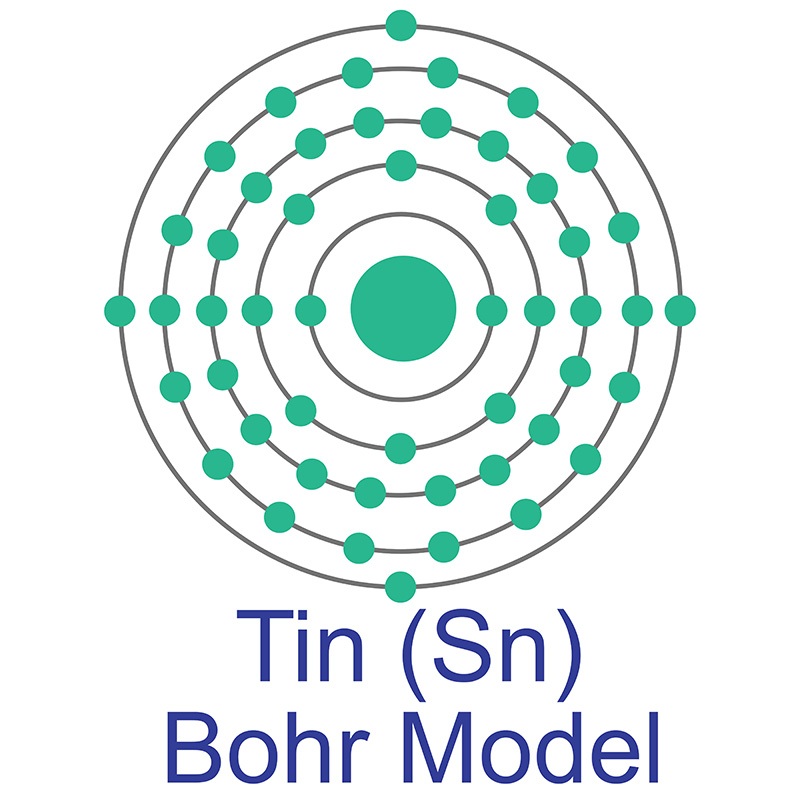
Tin(Sn) atomic and molecular weight, atomic number and elemental symbolTin is a Block P, Group 14, Period 5 element. The number of electrons in each of Tin's shells is 2, 8, 18, 18, 4 and its electronic configuration is [Kr] 4d10 5s2 5p2. In its elemental form tin's CAS number is 7440-31-5. The tin atom has a radius of 140.5.pm and it's Van der Waals radius is 217.pm. Organometallic compounds of tin are very toxic and tin salts are also considered to be toxic. Tin as single atoms or molecules are not toxic. Tin compounds sprayed onto glass are used to produce electrically conductive coatings. These have been used for panel lighting and for frost-free windshields. Most window glass is now made by floating molten glass on molten tin (float glass) to produce a flat surface. Crystalline tin-niobium alloy is superconductive at very low temperatures. This Tin (Sn) Bohr Modelpromises to be important in the construction of superconductive magnets Elemental Tinthat generate enormous field strengths but use practically no power. Tin is the basis for many eutectic alloys and the discovery by early man that copper could be better formed and crafted if tin were added producing the first bronze and launching what we refer to as the "Bronze Age" and the first Neolithic metal tools, cooking utensils, and jewelry produced from rudimentary bronze. An important tin compound is the chloride, which is used as a reducing agent and as a mordant in calico printing. Tin is also used in various metal alloys (See AE Alloys). Tin was first discovered by Early Man.The origin of the word tin comes from the Latin word Stannum which translates to the Anglo-Saxon word tin. See Tin research below.

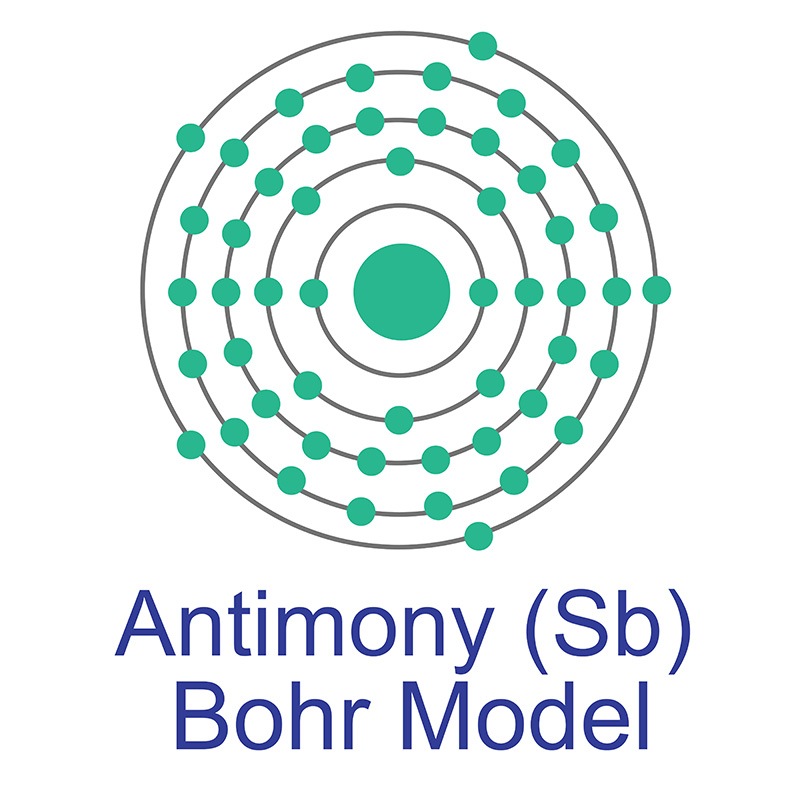
Antimony(Sb)atomic and molecular weight, atomic number and elemental symbolAntimony is a Block P, Group 15, Period 5 element. The number of electrons in each of Antimony's shells is 2, 8, 18, 18, 5 and its electronic configuration is [Kr] 4d10 5s2 5p3. In its elemental form antimony's CAS number is 7440-36-0. The antimony atom has a radius of 145.pm and it's Van der Waals radius is 200.pm. The chemical state of antimony affects the toxicity of the element and itsElemental Antimony compounds. Antimony is finding use in semiconductor technology for making infrared detectors, diodes and Hall-effect devices in crystalline structures, such as antimony telluride and gallium antimonide. Antimony is however a poor conductor of heat and electricity. It greatly increases the hardness and mechanical strength of lead.Antimony Bohr Model This has found applications in batteries, antifriction alloys, small arms and tracer bullets and cable sheathing. Antimony compounds are used in manufacturing flame-proofing compounds, paints, ceramic enamels, glass, and pottery glazes. Antimony is available as metal and compounds with purities from 99% to 99.9999% (ACS grade to ultra-high purity); metals in the form of foil, sputtering target, and rod, and compounds as submicron and nanopowder. See Antimony research below.

Have a Question? Ask a Chemical Engineer or Material Scientist   Request an MSDS or Certificate of Analysis

 
Toxicity
Safety & Handling
  Exclamation Mark-Acute Toxicity
Signal Word Hazard Statements Hazard Codes Risk Codes Safety Precautions RTECS No. Transport Information WGK Germany
Warning H319-H335  Xi 36/37 26 XP7320000 N/A 3


PACKAGING SPECIFICATIONS FOR BULK & RESEARCH QUANTITIES


Typical bulk packaging includes palletized plastic 5 gallon/25 kg. pails, fiber and steel drums to 1 ton super sacks in full container (FCL) or truck load (T/L) quantities. Research and sample quantities and hygroscopic, oxidizing or other air sensitive materials may be packaged under argon or vacuum. Shipping documentation includes a Certificate of Analysis and Material Safety Data Sheet (MSDS). Bullion and bar forms are best if purchasing solely for physical possession and risk exposure.


Show me more forms of Tin
 
Customers for this product have also looked at:
Bismuth Indium Tin Alloy Tin Acetate Tin Metal Tin Oxide Tin Chloride
Tin Pellets Tin Oxide Pellets Gold Tin Alloy Tin Nitrate Tin Acetylacetonate
Tin Foil Tin Rod Tin Nanoparticles Tin Powder Tin Sputtering Target


Search by Material, Product Name, Product Code, CAS Number, Formula, Element, Anion, Form, EC Number, MDL Number or PubChem ID.


German   Korean   French   Japanese   Spanish   Chinese (Simplified)   Portuguese   Russian   Chinese (Taiwan)   Italian   Turkish   Polish   Dutch   Czech   Swedish   Hungarian   Danish   Hebrew

Production Catalog Available in 36 Countries & Languages


Recent Research & Development for Tin

  • RECONSTRUCTION OF THE THUMB WITH A MODIFIED WRAP-AROUND FLAP IN A PATIENT SUFFERING FROM ?-THALASSEMIA MINOR. Galeano M, Checcucci G, Ceruso M. Hand Surg. 2011;16(3):361-5. PMID: 22072476 [PubMed - in process]

  • Isolated complete volar dislocation of the capitate: a case report. Checcucci G, Bigazzi P, Zucchini M, Ceruso M. Hand Surg. 2011;16(3):353-6. PMID: 22072474 [PubMed - in process]

  • Dielectrophoretic chip with multilayer electrodes and micro-cavity array for trapping and programmably releasing single cells. Chuang CH, Huang YW, Wu YT. Biomed Microdevices. 2011 Nov 10. [Epub ahead of print] PMID: 22072154 [PubMed - as supplied by publisher]

  • Structures of medium sized tin cluster anions. Wiesel A, Drebov N, Rapps T, Ahlrichs R, Schwarz U, Kelting R, Weis P, Kappes MM, Schooss D. Phys Chem Chem Phys. 2011 Nov 9. [Epub ahead of print] PMID: 22071636 [PubMed - as supplied by publisher]

  • Discrimination task reveals differences in neural bases of tinnitus and hearing impairment. Husain FT, Pajor NM, Smith JF, Kim HJ, Rudy S, Zalewski C, Brewer C, Horwitz B. PLoS One. 2011;6(10):e26639. Epub 2011 Oct 31. PMID: 22066003 [PubMed - in process]

  • A suggested technique for the application of the cone beam computed tomography periapical index. Esposito S, Cardaropoli M, Cotti E. Dentomaxillofac Radiol. 2011 Dec;40(8):506-12. PMID: 22065800 [PubMed - in process]

  • (4-Chloro-3-nitro-benzoato)triphenyl-tin(IV). Win YF, Choong CS, Teoh SG, Quah CK, Fun HK. Acta Crystallogr E Struct Rep Online. 2011 Sep 1;67(Pt 9):m1270-1. Epub 2011 Aug 27. PMID: 22065496 [PubMed]

  • Bis{2-[(E)-(5-tert-butyl-2-hy-droxy-phen-yl)diazen-yl]benzoato}dimethyl-tin(IV). Basu Baul TS, Paul A, Tiekink ER. Acta Crystallogr E Struct Rep Online. 2011 Oct 1;67(Pt 10):m1383-4. Epub 2011 Sep 14. PMID: 22065466 [PubMed]

  • Chloridodiphen-yl{[1-(1,3-thia-zol-2-yl-?N)ethyl-idene]-4-phenyl-thio-semicarbazidato-?N,S}tin(IV) methanol monosolvate. Arumugam SR, Dasary SS, Venkatraman R, Yu H, Fronczek FR. Acta Crystallogr E Struct Rep Online. 2011 Oct 1;67(Pt 10):m1409-10. Epub 2011 Sep 30. PMID: 22065366 [PubMed]

  • catena-Poly[[triphenyl-tin(IV)]-?-5-amino-2-nitro-benzoato-?O:O]. Win YF, Choong CS, Teoh SG, Quah CK, Fun HK. Acta Crystallogr E Struct Rep Online. 2011 Sep 1;67(Pt 9):m1276-7. Epub 2011 Aug 27. PMID: 22064934 [PubMed]

  • Dual detection strategy for electrochemical analysis of glucose and nitrite using a partitionally modified electrode. Wang J, Diao P, Zhang Q. Analyst. 2011 Nov 7. [Epub ahead of print] PMID: 22064849 [PubMed - as supplied by publisher]

  • fac-(2-Amido-ethyl-?C,O)trichlorido(urea-?O)tin(IV). Howie RA, de Lima GM, Tiekink ER, Wardell JL, Wardell SM. Acta Crystallogr E Struct Rep Online. 2011 Oct 1;67(Pt 10):m1420-1. Epub 2011 Sep 30. PMID: 22064619 [PubMed]

  • Highly sensitive nonenzymatic glucose sensor based on electrospun copper oxide-doped nickel oxide composite microfibers. Cao F, Guo S, Ma H, Yang G, Yang S, Gong J. Talanta. 2011 Oct 30;86:214-20. Epub 2011 Sep 8. PMID: 22063533 [PubMed - in process]

  • Cross-Linked Perylene Diimide-Based n-Type Interfacial Layer for Inverted Organic Photovoltaic Devices. Hains AW, Chen HY, Reilly TH, Gregg BA. ACS Appl Mater Interfaces. 2011 Nov 7. [Epub ahead of print] PMID: 22059439 [PubMed - as supplied by publisher]

  • Bis-(chloro-acetato-?O)bis(trimethyl-silylmethyl)tin(IV). Ding RF, Wang QB. Acta Crystallogr E Struct Rep Online. 2011 Sep 1;67(Pt 9):m1190. Epub 2011 Aug 2. PMID: 22058841 [PubMed]

  • A new langbeinite-type phosphate: K(2)AlSn(PO(4))(3). Li HY, Zhao D. Acta Crystallogr E Struct Rep Online. 2011 Oct 1;67(Pt 10):i56. Epub 2011 Sep 20. PMID: 22058680 [PubMed]

  • Enhanced resistance of yeast mutants deficient in low-affinity iron and zinc transporters to stannous-induced toxicity. Viau CM, Cardone JM, Guecheva TN, Yoneama ML, Dias JF, Pungartnik C, Brendel M, Saffi J, Henriques JA. Chemosphere. 2011 Nov 2. [Epub ahead of print] PMID: 22055569 [PubMed - as supplied by publisher]

  • Allylsilanes in "Tin-free" Oximation, Alkenylation, and Allylation of Alkyl Halides. Rouquet G, Robert F, Méreau R, Castet F, Landais Y. Chemistry. 2011 Nov 3. doi: 10.1002/chem.201101842. [Epub ahead of print] PMID: 22052660 [PubMed - as supplied by publisher]

  • Surface Modification of Indium-Tin-Oxide Via Self-Assembly of a Donor-Acceptor Complex: A Density Functional Theory Study. Li H, Winget P, Bredas JL. Adv Mater. 2011 Nov 3. doi: 10.1002/adma.201103009. [Epub ahead of print] No abstract available. PMID: 22052626 [PubMed - as supplied by publisher]

  • Minimally invasive video-assisted cardiac surgery: operative techniques, application fields and clinical outcomes. Vistarini N, Aiello M, Viganň M. Future Cardiol. 2011 Nov;7(6):775-87. PMID: 22050064 [PubMed - in process]

Recent Research & Development for Antimonides

  • Solution synthesis of nanoparticular binary transition metal antimonides. Kieslich G, Birkel CS, Stewart A, Kolb U, Tremel W. Inorg Chem. 2011 Aug 1;50(15):6938-43. Epub 2011 Jul 7. PMID: 21736318 [PubMed]

  • Electronic structure of thermoelectric Zn-Sb. Michael Böttger PH, Diplas S, Flage-Larsen E, Prytz Ø, Finstad TG. J Phys Condens Matter. 2011 Jul 6;23(26):265502. Epub 2011 Jun 13. PMID: 21666302 [PubMed]

  • Ternary and higher pnictides; prospects for new materials and applications. Cameron JM, Hughes RW, Zhao Y, Gregory DH. Chem Soc Rev. 2011 Jul;40(7):4099-118. Epub 2011 Mar 21. Review. PMID: 21423924 [PubMed - indexed for MEDLINE]

  • High pressure phase transition and elastic properties of covalent heavy rare-earth antimonides. Bhardwaj P, Singh S. J Mol Model. 2011 Dec;17(12):3057-62. Epub 2011 Mar 1. PMID: 21360178 [PubMed - indexed for MEDLINE]

  • Complex alloys containing double-Mackay clusters and (Sb(1-d)Zn(d))(24) snub cubes filled with highly disordered zinc aggregates: synthesis, structures, and physical properties of ruthenium zinc antimonides. Xiong DB, Zhao Y, Schnelle W, Okamoto NL, Inui H. Inorg Chem. 2010 Dec 6;49(23):10788-97. Epub 2010 Oct 28. PMID: 21028777 [PubMed]

  • Synthesis, crystal and electronic structures of the new quaternary phases A5Cd2Sb5F (A = Sr, Ba, Eu), and Ba5Cd2Sb5O(x) (0.5 <0.7). Saparov B, Bobev S. Dalton Trans. 2010 Dec 21;39(47):11335-43. Epub 2010 Oct 14. PMID: 20944855 [PubMed]

  • Novel ternary alkaline-earth and rare-earth metal antimonides from gallium or indium flux. Synthesis, structural characterization and 121Sb and 151Eu Mössbauer spectroscopy of the series A7Ga8Sb8 (A = Sr, Ba, Eu) and Ba7In8Sb8. Bobev S, Hullmann J, Harmening T, Pöttgen R. Dalton Trans. 2010 Jul 14;39(26):6049-55. Epub 2010 Jan 14. PMID: 20571648 [PubMed]

  • High-temperature transport properties of complex antimonides with anti-Th3P4 structure. Chamoire A, Gascoin F, Estournès C, Caillat T, Tédenac JC. Dalton Trans. 2010 Jan 28;39(4):1118-23. Epub 2009 Oct 30. PMID: 20066200 [PubMed]

  • Electron-poor antimonides: complex framework structures with narrow band gaps and low thermal conductivity. Häussermann U, Mikhaylushkin AS. Dalton Trans. 2010 Jan 28;39(4):1036-45. Epub 2009 Oct 16. PMID: 20066189 [PubMed]

  • Ge pairs and Sb ribbons in rare-earth germanium antimonides RE12Ge(7-x)Sb21 (RE = La-Pr). Bie H, Mar A. Chem Asian J. 2009 Sep 1;4(9):1465-73. PMID: 19554602 [PubMed]

  • Zn(5)Sb(4)In(2-delta) - a ternary derivative of thermoelectric zinc antimonides. Wu Y, Lidin S, Groy TL, Newman N, Häussermann U. Inorg Chem. 2009 Jul 6;48(13):5996-6003. PMID: 19476316 [PubMed]

  • Structures and physical properties of rare-earth zinc antimonides Pr6Zn(1+x)Sb(14+y) and RE6Zn(1+x)Sb14 (RE = Sm, Gd-Ho). Liu Y, Chen L, Li LH, Wu LM, Zelinska OY, Mar A. Inorg Chem. 2008 Dec 15;47(24):11930-41. PMID: 18998668 [PubMed]

  • Ternary rare-earth titanium antimonides RE2Ti(11-x)Sb(14+x) (RE = Sm, Gd, Tb, Yb). Bie H, Mar A. Inorg Chem. 2008 Aug 4;47(15):6763-70. Epub 2008 Jul 11. PMID: 18616241 [PubMed]

  • Unusual Sb-Sb bonding in high temperature thermoelectric materials. Xu J, Kleinke H. J Comput Chem. 2008 Oct;29(13):2134-43. PMID: 18432619 [PubMed]

  • Rare-earth metal-rich antimonides: syntheses, structures, and properties of Tm(3)Sb and Lu(7)Sb(3). Gupta S, Chen L, Ganguli AK, Corbett JD. Inorg Chem. 2007 Mar 19;46(6):2187-92. Epub 2007 Feb 16. PMID: 17302406 [PubMed]

  • Nanoscale zinc antimonides: synthesis and phase stability. Schlecht S, Erk C, Yosef M. Inorg Chem. 2006 Feb 20;45(4):1693-7. PMID: 16471982 [PubMed]

  • Structure and bonding of zinc antimonides: complex frameworks and narrow band gaps. Mikhaylushkin AS, Nylén J, Häussermann U. Chemistry. 2005 Aug 19;11(17):4912-20. PMID: 15940737 [PubMed]

  • Probing the limits of the Zintl concept: structure and bonding in rare-earth and alkaline-earth zinc-antimonides Yb9Zn4+xSb9 and Ca9Zn4.5Sb9. Bobev S, Thompson JD, Sarrao JL, Olmstead MM, Hope H, Kauzlarich SM. Inorg Chem. 2004 Aug 9;43(16):5044-52. PMID: 15285681 [PubMed]

  • Electrochemical properties of CoFe3Sb12 as potential anode material for lithium-ion batteries. Zhao XB, Zhong YD, Cao GS. J Zhejiang Univ Sci. 2004 Apr;5(4):418-21. PMID: 14994430 [PubMed - indexed for MEDLINE]

  • MA(delta)Sb(2-delta) (M = Zr, Hf; A = Si, Ge): a new series of ternary antimonides and not "beta-ZrSb2". Soheilnia N, Assoud A, Kleinke H. Inorg Chem. 2003 Nov 3;42(22):7319-25. PMID: 14577804 [PubMed]


Aeromat 2012 Sponsor
Proud sponsors of Aeromat 2012. Please join us and our customers & co-sponsors Boeing and ATI on June 18-20, 2012
in Charlotte, North Carolina

PRODUCT CATALOG Tin Products News Foil Submicron & Nanopowder Tolling Ultra High Purity Sputtering Target Crystal Growth Rod, Plate, Powder, etc. Home

  Print this Page
Periodic table of the elements science and academic information, elements and advanced materials data, scientific presentations and all pages, designs, concepts, logos, and color schemes herein are the copyrighted proprietary rights and intellectual property of American Elements. American Elements is a U.S. Registered Trademark. © 1998-2012. American Elements. All rights reserved.
Learn Six Sigma


American Elements is a copyrighted U.S. Trademark. All rights reserved.