Tm:YVO4 is a crystalline solid used as a semiconductor and in photo optic applications.American Elements produces to many standard grades when applicable, including Mil Spec (military grade); ACS, Reagent and Technical Grade; Food, Agricultural and Pharmaceutical Grade; Optical Grade, USP and EP/BP (European Pharmacopoeia/British Pharmacopoeia)and follows applicable ASTM testing standards.Typical and custom packaging is available. Additional technical, research and safety (MSDS) information is available as is a Reference Calculator for converting relevant units of measurement.
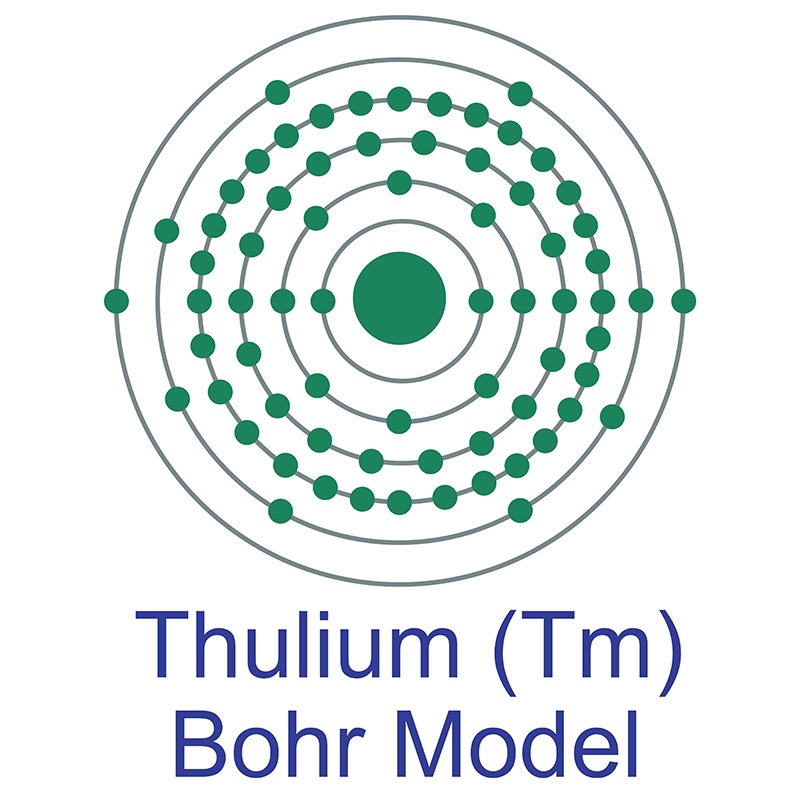
Thulium is a Block F, Group 3, Period 6 element. The number of electrons in each of Thulium's shells is 2, 8, 18, 31, 8, 2 and its electronic configuration is [Xe]4f136s2. In its elemental form thulium's CAS number is 7440-30-4. The thulium atom has a radius of 172.4.pm and it's Van der Waals radius is unknown. Thulium is not toxic. Thulium is representative of the other lanthanides (rare earths) similar in chemistry to Yttrium. Thulium is available as metal and compounds with purities from 99% to 99.999% (ACS grade to ultra-high purity); metals in the form of foil, sputtering target, and rod, and compounds as submicron and nanopowder. Thulium emits blue upon excitation. Flat panel screens depend critically on bright blue emitters. Also, under X-ray bombardment emissions are in both the 375 nm (ultra violet) and 465 (visible blue) wave lengths. This gives the material useful applications in low radiation detection for detection badges and similar uses. It is also used in other luminescence applications, such as halide discharge lamps. Thulium was first discovered by Theodore Cleve in 1879. Thulium is named after "Thule", which is the ancient name of Scandinavia. See Thulium research below.
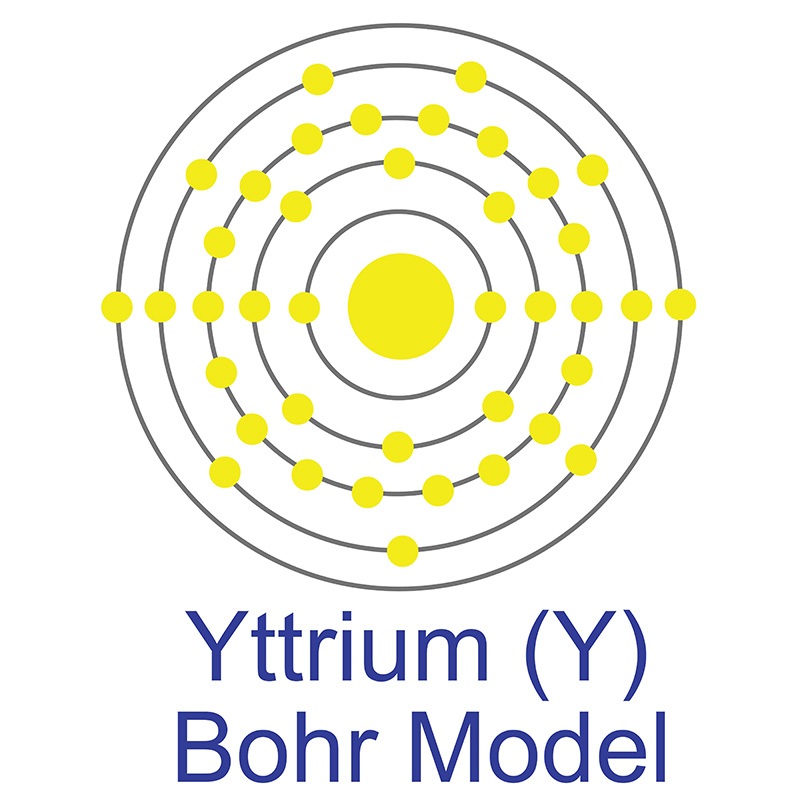
Yttrium is a Block D, Group 3, Period 5 element. The number of electrons in each of Yttrium's shells is 2, 8, 18, 9, 2 and its electronic configuration is [Kr] 4d1 5s2. In its elemental form Yttrium's CAS number is 7440-65-5. The yttrium atom has a radius of 177.6.pm and it's Van der Waals radius is 200.pm. Insoluble compounds of Yttrium are non-toxic, although water soluble compounds are somewhat toxic. Yttrium has the highest thermo-dynamic affinity for oxygen of any element. This characteristic is the basis for many of its applications. While not part of the rare earth series, it resembles the heavy rare earths which are sometimes referred to as the “yttrics” for this reason. Another unique characteristic derives from its ability to form crystals with useful properties. Yttrium is available as metal and compounds with purities from 99% to 99.999% (ACS grade to ultra high purity); metals in the form of foil, sputtering target, and rod, and compounds assubmicron and nanopowder. Some of the many applications of yttrium include in ceramics for crucibles for molten reactive metals, in florescent lighting phosphors, computer displays and automotive fuel consumption sensors.Yttria stabilized zirconium oxide are used in high temperature applications, such as in thermal plasma sprays to protect aerospace high temperature surfaces and as an electrolyte in solid oxide fuel cells. The name Yttrium originated from a Swedish village near Vaxholm called Yttbery where Yttrium was discovered. Crystals of the yttrium-iron-garnet (YIG) variety are essential to microwave communication equipment. The phosphor Eu:Y2O2S creates the red color in televisions. Crystals of the yttrium-aluminum-garnet (YAG) variety are utilized with neodymium in a number of laser applications. Yttria can also increase the strength of metallic alloys. Yttrium was first discovered by Johann Gadolin in 1794. See Yttrium research below.
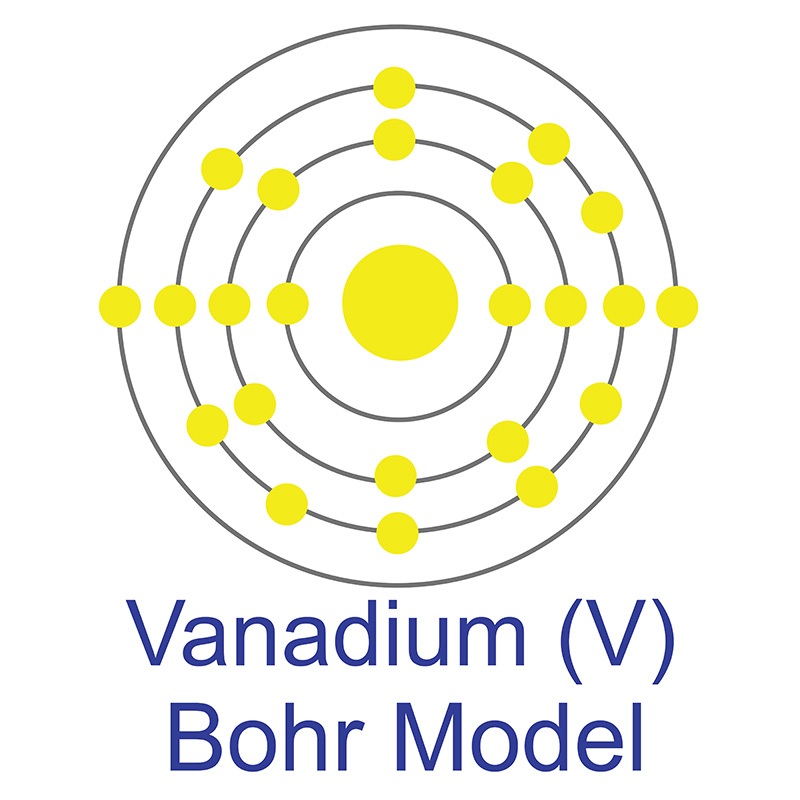
Vanadium is a Block D, Group 5, Period 4 element. The number of electrons in each of Vanadium's shells is 2, 8, 11, 2 and its electronic configuration is [Ar] 3d3 4s2. In its elemental form vanadium's CAS number is 7440-62-2. The vanadium atom has a radius of 131.1.pm and it's Van der Waals radius is 200.pm. Several vanadium compounds are toxic to some creatures despite the fact that it is an essential trace element. Vanadium is highly resistant to corrosion, so it is commonly used to alloy stainless steel grades. Vanadium compounds are used in advanced ceramics. Vanadium is a petrochemical cracking catalyst. Vanadium is available as metal and compounds with purities from 99% to 99.999% (ACS grade to ultra-high purity); metals in the form of foil, sputtering target, and rod, and compounds as submicron and nanopowder. Vanadium information, including Technical Data, Safety Data and its high purity properties , research , applications and other useful facts are discussed here . Scientific facts such as the atomic structure, ionization energy , abundance on Earth , conductivity and thermal properties are included. Vanadium was first discovered in Mexico City by Andres Manuel del Rio, a Spanish born and European educated Mexican mineralogist, in 1801. In honor of its beautiful multi-colored compounds, Vanadium was named after the word "Vanadis" meaning goddess of beauty in Scandinavian mythology. See Vanadium research below.
American Elements semi conducting materials are crystal structures produced from ultra high purity starting materials synthesized by our high purity production facility which includes several large electric muffle furnaces, a tube furnace for hydrogen reduction, 50 gallon glass-lined Pfaudler reactors supported by our analytical laboratory containing X-ray diffraction, SEM, AA, BET surface area, and ICP Spectrometry for trace metals analysis. See a discussion of American Elements Ultra High Purity and Analytical capabilities. See Crystal Growth for processes used to fabricate semiconductor materials, which include:
Crystal "pulling" by the Czochaiski method for production of semiconductor materials
Flux growth and gradient freeze
Directional solidification of fluorites using both the Bridgman-Stockbarger and float zoning techniques
Efficient diode-pumped laser operation of Tm:Lu2O3 around 2?µm.
Koopmann P, Lamrini S, Scholle K, Fuhrberg P, Petermann K, Huber G.
Opt Lett. 2011 Mar 15;36(6):948-50. doi: 10.1364/OL.36.000948.
PMID:
21403738
[PubMed - in process]
Comparison of high-dose rate prostate brachytherapy dose distributions with iridium-192, ytterbium-169, and thulium-170 sources.
Krishnamurthy D, Weinberg V, Cunha JA, Hsu IC, Pouliot J.
Brachytherapy. 2011 Mar 10. [Epub ahead of print]
PMID:
21397569
[PubMed - as supplied by publisher]
Theoretical modeling of fiber laser at 810 nm based on thulium-doped silica fibers with enhanced 3H4 level lifetime.
Peterka P, Kasik I, Dhar A, Dussardier B, Blanc W.
Opt Express. 2011 Jan 31;19(3):2773-81. doi: 10.1364/OE.19.002773.
PMID:
21369098
[PubMed - in process]
Picosecond tunable mode locking of a Cr2+:ZnSe laser with a nonlinear mirror.
Dherbecourt JB, Denoeud A, Melkonian JM, Raybaut M, Godard A, Lefebvre M, Rosencher E.
Opt Lett. 2011 Mar 1;36(5):751-3. doi: 10.1364/OL.36.000751.
PMID:
21368971
[PubMed - in process]
Spectral narrowing and stabilization of thulium fiber lasers using guided-mode resonance filters.
Sims RA, Roth ZA, Willis CC, Kadwani P, McComb TS, Shah L, Sudesh V, Poutous M, Johnson EG, Richardson M.
Opt Lett. 2011 Mar 1;36(5):737-9. doi: 10.1364/OL.36.000737.
PMID:
21368966
[PubMed - in process]
Dissipative dispersion-managed soliton 2?µm thulium/holmium fiber laser.
Gumenyuk R, Vartiainen I, Tuovinen H, Okhotnikov OG.
Opt Lett. 2011 Mar 1;36(5):609-11. doi: 10.1364/OL.36.000609.
PMID:
21368923
[PubMed - in process]
1,927-nm Fractional Thulium Fiber Laser for the Treatment of Nonfacial Photodamage: A Pilot Study.
Polder KD, Harrison A, Eubanks LE, Bruce S.
Dermatol Surg. 2011 Mar;37(3):342-8. doi: 10.1111/j.1524-4725.2011.01884.x. Epub 2011 Feb 22.
PMID:
21342312
[PubMed - in process]
In situ synthesis of thulium(III) hexacyanoferrate(II) nanoparticles and its application for glucose detection.
Meng Z, Zheng J, Sheng Q, Zheng X.
Anal Chim Acta. 2011 Mar 9;689(1):47-51. Epub 2011 Jan 19.
PMID:
21338755
[PubMed - in process]
Ceramic Bracket Debonding by Tm:YAP Laser Irradiation.
Dostalova T, Jelinkova H, Sulc J, Nemec M, Jelinek M, Fibrich M, Michalik P, Miyagi M, Seydlova M.
Photomed Laser Surg. 2011 Feb 20. [Epub ahead of print]
PMID:
21332377
[PubMed - as supplied by publisher]
[Study on thulium oxide nanoparticles modulating electro-optics characteristics of polymer dispersed liquid crystals].
Liu GX, Jin X, Wu HY, Wang GX, Lu Y.
Guang Pu Xue Yu Guang Pu Fen Xi. 2010 Nov;30(11):2911-3. Chinese.
PMID:
21284151
[PubMed - in process]
Eye-safe 2 µm luminescence from thulium-doped silicon.
Lourenço M, Gwilliam R, Homewood K.
Opt Lett. 2011 Jan 15;36(2):169-71. doi: 10.1364/OL.36.000169.
PMID:
21263489
[PubMed - in process]
Broadband waveguide quantum memory for entangled photons.
Saglamyurek E, Sinclair N, Jin J, Slater JA, Oblak D, Bussières F, George M, Ricken R, Sohler W, Tittel W.
Nature. 2011 Jan 27;469(7331):512-5. Epub 2011 Jan 12.
PMID:
21228775
[PubMed]
Infrared skin damage thresholds from 1940-nm continuous-wave laser exposures.
Oliver JW, Stolarski DJ, Noojin GD, Hodnett HM, Harbert CA, Schuster KJ, Foltz MF, Kumru SS, Cain CP, Finkeldei CJ, Buffington GD, Noojin ID, Thomas RJ.
J Biomed Opt. 2010 Nov-Dec;15(6):065008.
PMID:
21198172
[PubMed - in process]
Use of 2-µm Continuous-Wave Thulium Laser for Surgical Removal of a Tentorial Meningioma: Case Report.
Passacantilli E, Anichini G, Delfinis CP, Lenzi J, Santoro A.
Photomed Laser Surg. 2010 Dec 23. [Epub ahead of print]
PMID:
21182448
[PubMed - as supplied by publisher]
Watt-level ~2 µm laser output in Tm3+-doped tungsten tellurite glass double-cladding fiber.
Li K, Zhang G, Hu L.
Opt Lett. 2010 Dec 15;35(24):4136-8. doi: 10.1364/OL.35.004136.
PMID:
21165115
[PubMed - in process]
Effect of temperature on spectroscopic features relevant to laser performance of YVO4:Tm3+, GdVO4:Tm3+, and LuVO4:Tm3+ crystals.
Lisiecki R, Solarz P, Dominiak-Dzik G, Ryba-Romanowski W, Lukasiewicz T.
Opt Lett. 2010 Dec 1;35(23):3940-2. doi: 10.1364/OL.35.003940.
PMID:
21124572
[PubMed - in process]
Fluence of thulium laser system in skin ablation.
Bilici T, Tabakoglu O, Kalaycioglu H, Kurt A, Sennaroglu A, Gülsoy M.
Conf Proc IEEE Eng Med Biol Soc. 2010;2010:3218-21.
PMID:
21096601
[PubMed - in process]
New advances in benign prostatic hyperplasia: laser therapy.
Mandeville J, Gnessin E, Lingeman JE.
Curr Urol Rep. 2011 Feb;12(1):56-61.
PMID:
21088938
[PubMed - in process]
High-power widely tunable thulium fiber lasers.
McComb TS, Sims RA, Willis CC, Kadwani P, Sudesh V, Shah L, Richardson M.
Appl Opt. 2010 Nov 10;49(32):6236-42. doi: 10.1364/AO.49.006236.
PMID:
21068854
[PubMed - in process]
Low-Fluence Q-Switched 1,064-nm Neodymium-Doped Yttrium Aluminum Garnet Laser for the Treatment of Facial Partial Unilateral Lentiginosis in Koreans.
Lee Y, Choi EH, Lee SW.
Dermatol Surg. 2011 Sep 7. doi: 10.1111/j.1524-4725.2011.02147.x. [Epub ahead of print]
PMID:
22093176
[PubMed - as supplied by publisher]
Successful Treatment of Cosmetic Mucosal Tattoos Via Q-Switched Laser.
Kirby W, Chen C, Desai A, Desai T.
Dermatol Surg. 2011 Aug 23. doi: 10.1111/j.1524-4725.2011.02135.x. [Epub ahead of print]
PMID:
22093036
[PubMed - as supplied by publisher]
Letter: successful treatment of multiple miliary osteomas of the face using an erbium-doped yttrium aluminum garnet laser.
Ortiz AE, Ross EV.
Dermatol Surg. 2011 Oct;37(10):1548-50. doi: 10.1111/j.1524-4725.2011.02112.x.
PMID:
22092945
[PubMed - in process]
Commentary on Treatment of Acne Scars in Asian Patients using a 2,790-nm Fractional Yttrium Scandium Gallium Garnet Laser.
Perez M.
Dermatol Surg. 2011 Oct;37(10):1470-2. doi: 10.1111/j.1524-4725.2011.02116.x. No abstract available.
PMID:
22092942
[PubMed - in process]
Fractional Thermoablation Using an Erbium-Doped Yttrium Aluminum Garnet Fractionated Laser for the Treatment of Pulsed Dye Laser-Resistant Port Wine Stain Birthmarks.
Toren KL, Marquart JD.
Dermatol Surg. 2011 Sep 14. doi: 10.1111/j.1524-4725.2011.02160.x. [Epub ahead of print] No abstract available.
PMID:
22092921
[PubMed - as supplied by publisher]
The effect of erbium-doped: yttrium, aluminium and garnet laser irradiation on the surface microstructure and roughness of double acid-etched implants.
Kim JH, Herr Y, Chung JH, Shin SI, Kwon YH.
J Periodontal Implant Sci. 2011 Oct;41(5):234-41. Epub 2011 Oct 31.
PMID:
22087414
[PubMed - in process]
120-W 2-?m THULIUM:YTTRIUM-ALUMINIUM-GARNET VAPOENUCLEATION OF THE PROSTATE: 12-MONTH FOLLOW-UP.
Muir G.
BJU Int. 2011 Nov 15. doi: 10.1111/j.1464-410X.2011.10816.x. [Epub ahead of print] No abstract available.
PMID:
22085314
[PubMed - as supplied by publisher]
120-W 2-µm thulium:yttrium-aluminium-garnet vapoenucleation of the prostate: 12-month follow-up.
Netsch C, Pohlmann L, Herrmann TR, Gross AJ, Bach T.
BJU Int. 2011 Nov 15. doi: 10.1111/j.1464-410X.2011.10767.x. [Epub ahead of print]
PMID:
22085294
[PubMed - as supplied by publisher]
An Unusual Organoyttrium Alkyl Complex Containing a [C(5) HMe(3) (?(3) -CH(2) )-C(5) H(4) N-?](-) Ligand and an Elusive Cyclopentadienide-Based Scandium Tuck-Over Zwitterion Obtained by C?H Bond Activation.
Jian Z, Cui D.
Chemistry. 2011 Nov 14. doi: 10.1002/chem.201102378. [Epub ahead of print]
PMID:
22083978
[PubMed - as supplied by publisher]
Radioembolization versus Standard Care of Hepatic Metastases: Comparative Retrospective Cohort Study of Survival Outcomes and Adverse Events in Salvage Patients.
Bester L, Meteling B, Pocock N, Pavlakis N, Chua TC, Saxena A, Morris DL.
J Vasc Interv Radiol. 2011 Nov 11. [Epub ahead of print]
PMID:
22079516
[PubMed - as supplied by publisher]
Quantitative evaluation of scintillation camera imaging characteristics of isotopes used in liver radioembolization.
Elschot M, Nijsen JF, Dam AJ, de Jong HW.
PLoS One. 2011;6(11):e26174. Epub 2011 Nov 3.
PMID:
22073149
[PubMed - in process]
Lasers or light sources for treating port-wine stains.
Faurschou A, Olesen AB, Leonardi-Bee J, Haedersdal M.
Cochrane Database Syst Rev. 2011 Nov 9;11:CD007152.
PMID:
22071834
[PubMed - in process]
Treating and Downstaging Hepatocellular Carcinoma in the Caudate Lobe with Yttrium-90 Radioembolization.
Ibrahim SM, Kulik L, Baker T, Ryu RK, Mulcahy MF, Abecassis M, Salem R, Lewandowski RJ.
Cardiovasc Intervent Radiol. 2011 Nov 9. [Epub ahead of print]
PMID:
22069121
[PubMed - as supplied by publisher]
catena-Poly[[tetra-kis-(hexa-methyl-phospho-ramide-?O)bis-(nitrato-?O,O')yttrium(III)] [silver(I)-di-?-sulfido-molybdenum(VI)-di-?-sulfido]].
Zhang J.
Acta Crystallogr E Struct Rep Online. 2011 Sep 1;67(Pt 9):m1206-7. Epub 2011 Aug 6.
PMID:
22065643
[PubMed]
Yttrium-90 Time-of-Flight PET/CT Is Superior to Bremsstrahlung SPECT/CT for Postradioembolization Imaging of Microsphere Biodistribution.
Kao YH, Tan EH, Ng CE, Goh SW.
Clin Nucl Med. 2011 Dec;36(12):e186-7.
PMID:
22064104
[PubMed - in process]
End-functionalized Polymerization of 2-Vinylpyridine through Initial C-H Bond Activation of N-Heteroaromatics and Internal Alkynes by Yttrium Ene-diamido Complexes.
Kaneko H, Nagae H, Tsurugi H, Mashima K.
J Am Chem Soc. 2011 Nov 7. [Epub ahead of print]
PMID:
22059504
[PubMed - as supplied by publisher]
Catalytic, Enantioselective Intramolecular Hydroamination of Primary Amines Tethered to Di- and Tri-substituted Alkenes.
Chapurina Y, Ibrahim H, Guillot R, Kolodziej E, Collin J, Trifonov A, Schulz E, Hannedouche J.
J Org Chem. 2011 Nov 7. [Epub ahead of print]
PMID:
22059438
[PubMed - as supplied by publisher]
Size effect of endohedral cluster on fullerene cage: Preparation and structural studies of Y(3)N@C(78)-C(2).
Ma Y, Wang T, Wu J, Feng Y, Xu W, Jiang L, Zheng J, Shu C, Wang C.
Nanoscale. 2011 Nov 7. [Epub ahead of print]
PMID:
22057827
[PubMed - as supplied by publisher]
MDCT Necrosis Quantification in the Assessment of Hepatocellular Carcinoma Response to Yttrium 90 Radioembolization Therapy: Comparison of Two-dimensional and Volumetric Techniques.
Galizia MS, Töre HG, Chalian H, McCarthy R, Salem R, Yaghmai V.
Acad Radiol. 2011 Nov 2. [Epub ahead of print]
PMID:
22054801
[PubMed - as supplied by publisher]
Q-switched laser treatment of amiodarone pigmentation.
Bernstein EF.
J Drugs Dermatol. 2011 Nov 1;10(11):1316-9.
PMID:
22052315
[PubMed - in process]