American Elements Logo and U.S. Registered Trademark


Nickel Zirconium Sputtering Target
High Purity Ni - Zr Sputtering Target
7440-02-0
Product Product Code Order or Specifications
(2N) 99% Nickel Zirconium Sputtering Target NI-ZR-02-ST Contact American Elements
(2N5) 99.5% Nickel Zirconium Sputtering Target NI-ZR-025-ST Contact American Elements
(3N) 99.9% Nickel Zirconium Sputtering Target NI-ZR-03-ST Contact American Elements
(3N5) 99.95% Nickel Zirconium Sputtering Target NI-ZR-035-ST Contact American Elements
(4N) 99.99% Nickel Zirconium Sputtering Target NI-ZR-04-ST Contact American Elements
(5N) 99.999% Nickel Zirconium Sputtering Target NI-ZR-05-ST Contact American Elements
American Elements produces to many standard grades when applicable, including Mil Spec (military grade); ACS, Reagent and Technical Grade; Food, Agricultural and Pharmaceutical Grade; Optical Grade, USP and EP/BP (European Pharmacopeia/British Pharmacopeia) and follows applicable ASTM testing standards.See safety data and research below and pricing/lead time above. American Elements specializes in producing high purity Nickel Zirconium Sputtering Targets with the highest possible density High Purity (99.99%) Metallic Sputtering Targetand smallest possible average grain sizes for use in semiconductor, chemical vapor deposition (CVD) and physical vapor deposition (PVD) display and optical applications. Our standard Sputtering Targets for thin film are available monoblock or bonded with dimensions and configurations up to 820 mm with hole drill locations and threading, beveling, grooves and backing designed to work with both older sputtering devises as well as the latest process equipment, such as large area coating for solar energy or fuel cells and flip-chip applications. Research sized targets are also produced as well as custom sizes and alloys. All targets are analyzed using best demonstrated techniques including X-Ray Fluorescence (XRF), Glow Discharge Mass Spectrometry (GDMS), and Inductively Coupled Plasma (ICP). "Sputtering" allows for thin film deposition of an ultra high purity sputtering metallic or oxide material onto another solid substrate by the controlled removal and conversion of the target material into a directed gaseous/plasma phase through ionic bombardment. We can also provide targets outside this range in addition to just about any size rectangular, annular, or oval target. Materials are produced using crystallization, solid state and other ultra high purification processes such as sublimation. American Elements specializes in producing custom compositions for commercial and research applications and for new proprietary technologies. American Elements also casts any of the rare earth metals and most other advanced materials into rod, bar or plate form, as well as other machined shapes and through other processes nanoparticles. We also produce Nickel as rods, powder and plates. Other shapes are available by request.

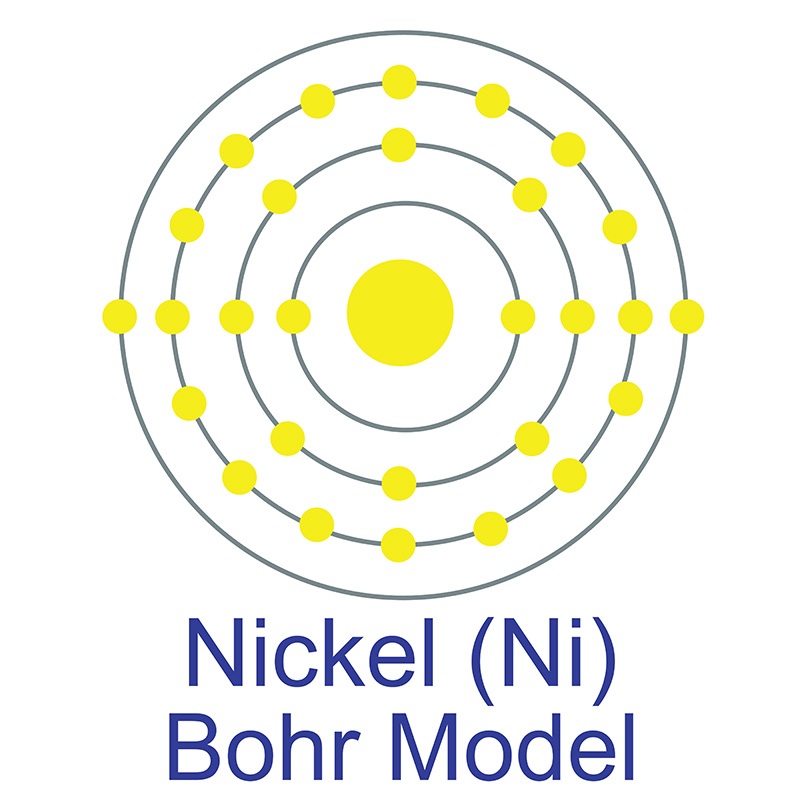
Nickel(Ni) atomic and molecular weight, atomic number and elemental symbolNickel is a Block D, Group 4, Period 4 element. The number of electrons in each of Nickel's shells is 2, 8, 16, 2 and its electronic configuration is [Ar]3d8 4s2. In its elemental form nickel's CAS number is 7440-02-0. Nickel is sometimes found free in nature but is more commonly found in ores. The nickel atom has a radius of 149.pm and it's Van der Waals radius is 163.pm. Nickel and its compounds are considered to be carcinogenic. Nickel carbonyl is a very toxic gas. It is extensively alloyed with iron, chromium, molybdenum, tungsten and other metals produce stainless and other anti-corrosive steel and other corrosion-resistant alloys. It is highly electronically conductive and has many applications as a result. It is the basis of the nickel hydride battery. Most recently, its Nickel Bohr Model conductive properties have Elemental Nickelmade it an ideal component for ceramic anode formulations used in oxygen generation and solid oxide fuel cell applications. Catalytic nickel is used to hydrogenate vegetable oils. Nickel additions to glass and ceramic glazes impart a bright green. It is also used in pigments for this purpose. Nickel information, including Technical Data, Safety Data and its high purity properties, research, applications and other useful facts are discussed below. Scientific facts such as the atomic structure, ionization energy, abundance on Earth, conductivity and thermal properties are included. Nickel was first discovered by Alex Constedt in 1751. The name originates from the German word 'kupfernickel' which means false copper from the illusory copper color of the ore. See Nickel research below.

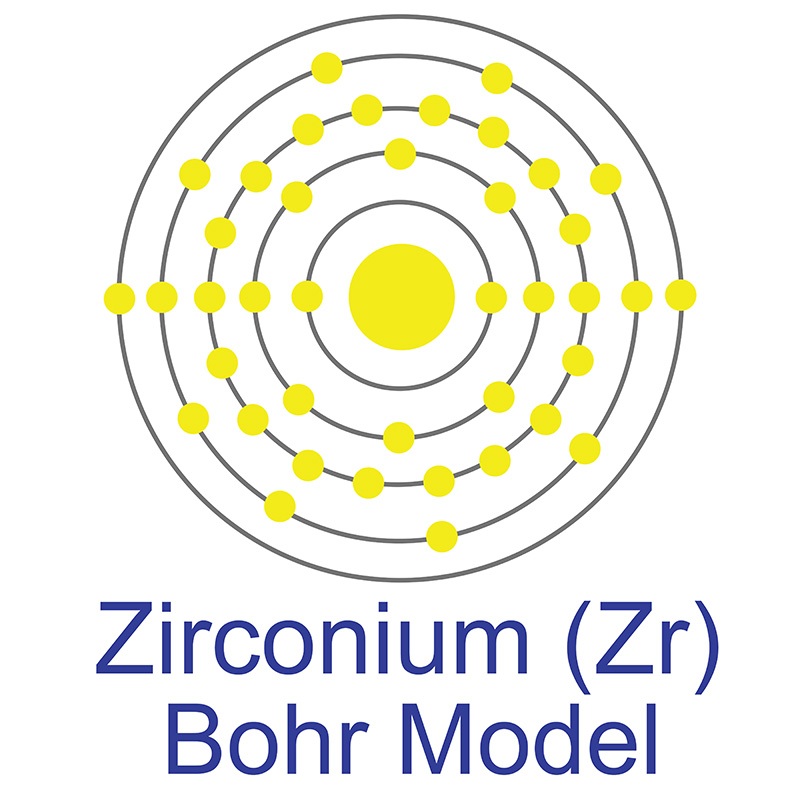
Zirconium(Zr) atomic and molecular weight, atomic number and elemental symbol Zirconium is a Block D, Group 4, Period 5 element. The number of electrons in each of Zirconium's shells is 2, 8, 18, 10, 2 and its electronic configuration is [Kr] 4d2 5s2. In its elemental form zirconium's CAS number is 7440-67-7. The zirconium atom has a radius of 159.pm and it's Van der Waals radius is 200.pm. Zirconium is non-toxic. Zirconium’s principal mineral is zircon (Zirconium Silicate) and is primarily used in its oxide or zirconia form. Zirconium dioxide has a high melting point (2,700° C) and a low thermal conductivity. Its polymorphism, however, restricts its widespread use in ceramic industry. During a heating process, zirconia will undergo a phase transformation process. The changeZirconium Bohr Model in volume associated with this transformation makes the usage of pure zirconia in many applications impossible. Addition of some oxides, such as CaO, MgO, and Y2O3, into the zirconia structure in a Elemental Zirconiumcertain degree results in a solid solution, which is a cubic form and has no phase transformation during heating and cooling. This solid solution material is termed as stabilized zirconia, a valuable refractory. Stabilized zirconia is used as a grinding media and engineering ceramics due to its increased hardness and high thermal shock resistivity. Stabilized zirconia is also used in applications such as oxygen sensors and solid oxide fuel cells due to its high oxygen ion conductivity.Zirconium was first discovered by William Gregor in 1791. The name Zirconium originated from the Persian word 'zargun' meaning gold color or gold-like. See Zirconium research below. Addition of some oxides, such as CaO, MgO, and Y2O3, into the zirconia structure in a certain degree results in a solid solution, which is a cubic form and has no phase transformation during heating and cooling. This solid solution material is termed as stabilized zirconia, a valuable refractory. Stabilized zirconia is used as a grinding media and engineering ceramics due to its increased hardness and high thermal shock resistivity. Stabilized zirconia is also used in applications such as oxygen sensors and solid oxide fuel cells due to its high oxygen ion conductivity.

Formula
CAS No.
Ni
Zr
7440-02-0
13967-71-0
PRODUCT CATALOG Nickel Products News Foil Submicron & Nanopowder Tolling Ultra High Purity Sputtering Target Crystal Growth Rod, Plate, Powder, etc. Home

Have a Question? Ask a Chemical Engineer or Material Scientist   Request an MSDS or Certificate of Analysis


Search by Material, Product Name, Product Code, CAS Number, Formula, Element, Anion, Form, EC Number, MDL Number or PubChem ID.
German   Korean   French   Japanese   Spanish   Chinese (Simplified)   Portuguese   Russian   Chinese (Taiwan)   Italian   Turkish   Polish   Dutch   Czech   Swedish   Hungarian   Danish   Hebrew

Production Catalog Available in 36 Countries & Languages

PACKAGING SPECIFICATIONS FOR BULK & RESEARCH QUANTITIES


Typical bulk packaging includes palletized plastic 5 gallon/25 kg. pails, fiber and steel drums to 1 ton super sacks in full container (FCL) or truck load (T/L) quantities. Research and sample quantities and hygroscopic, oxidizing or other air sensitive materials may be packaged under argon or vacuum. Shipping documentation includes a Certificate of Analysis and Material Safety Data Sheet (MSDS). Solutions are packaged in polypropylene, plastic or glass jars up to palletized 440 gallon liquid totes.


Show me more forms of Nickel


Customers for this product have also looked at:
Nickel Copper Iron Alloy Nickel Foil Nickel Nanoparticles Nickel Molybdenum Alloy Nickel Pellets
Nickel Oxide Pellets Nickel Powder Nickel Oxide Nickel Sputtering Target Nickel Acetylacetonate
Nickel Sulfate Nickel Metal Nickel Chloride Nickel Acetate Nickel Rod


Recent Research & Development for Nickel

  • Regioselective Cycloaddition of 3-Azetidinones and 3-Oxetanones with Alkynes through Nickel-Catalysed Carbon-Carbon Bond Activation. Y T Ho K, Aďssa C. Chemistry. 2012 Feb 22. doi: 10.1002/chem.201200167. [Epub ahead of print] PMID: 22359347 [PubMed - as supplied by publisher]

  • The hydrogen evolution reaction in a room temperature ionic liquid: mechanism and electrocatalyst trends. Meng Y, Aldous L, Belding SR, Compton RG. Phys Chem Chem Phys. 2012 Feb 22. [Epub ahead of print] PMID: 22358388 [PubMed - as supplied by publisher]

  • A cytosolic Ni(II) sensor in a cyanobacterium: Nickel-detection follows nickel-affinity across four families of metal-sensors. Foster AW, Patterson CJ, Pernil R, Hess CR, Robinson NJ. J Biol Chem. 2012 Feb 22. [Epub ahead of print] PMID: 22356910 [PubMed - as supplied by publisher]

  • Incorporation of metal and color alteration of enamel in the presence of orthodontic appliances. Gurgel Maia LH, de Lima Filho HL, Araújo MV, de Oliveira Ruellas AC, de Souza Araújo MT. Angle Orthod. 2012 Feb 23. [Epub ahead of print] PMID: 22356704 [PubMed - as supplied by publisher]

  • Nickel(II) and Palladium(II) Thiaethyneporphyrins. Intramolecular Metal(II)-?(2)-CC Interaction inside a Porphyrinoid Frame. Nojman E, Berlicka A, Szterenberg L, Latos-Grazynski L. Inorg Chem. 2012 Feb 22. [Epub ahead of print] PMID: 22356285 [PubMed - as supplied by publisher]

  • General preparation for Pt-based alloy nanoporous nanoparticles as potential nanocatalysts. Wang D, Zhao P, Li Y. Sci Rep. 2011;1:37. Epub 2011 Jul 14. PMID: 22355556 [PubMed - in process]

  • Pentacoordinate Ni(II) Complexes: Preparation, Magnetic Measurements, and Ab Initio Calculations of the Magnetic Anisotropy Terms. Costes JP, Maurice R, Vendier L. Chemistry. 2012 Feb 22. doi: 10.1002/chem.201103641. [Epub ahead of print] PMID: 22354459 [PubMed - as supplied by publisher]

  • [Measurement of carbon dioxide in emergency medicine]. Timmermann A, Brokmann JC, Fitzka R, Nickel EA. Anaesthesist. 2012 Feb;61(2):148-55. German. PMID: 22354403 [PubMed - in process]

  • [Care Counselling - The Client's Expectations.] Nickel W, Hanns S, Brähler E, Born A. Gesundheitswesen. 2012 Feb 21. [Epub ahead of print] German. PMID: 22354362 [PubMed - as supplied by publisher]

  • Community-based partnered research: new directions in mental health services research. Alegría M, Wong Y, Mulvaney-Day N, Nillni A, Proctor E, Nickel M, Jones L, Green B, Koegel P, Wright A, Wells KB. Ethn Dis. 2011 Summer;21(3 Suppl 1):S1-8-16. PMID: 22352075 [PubMed - in process]

  • Inverse Suspension Polymerization as a New Tool for the Synthesis of Ion-Imprinted Polymers. Meouche W, Branger C, Beurroies I, Denoyel R, Margaillan A. Macromol Rapid Commun. 2012 Feb 21. doi: 10.1002/marc.201200039. [Epub ahead of print] PMID: 22351426 [PubMed - as supplied by publisher]

  • Isolation and characterization of Bacillus cereus IST105 from electroplating effluent for detoxification of hexavalent chromium. Naik UC, Srivastava S, Thakur IS. Environ Sci Pollut Res Int. 2012 Feb 16. [Epub ahead of print] PMID: 22351260 [PubMed - as supplied by publisher]

  • Production of a his-tagged canecystatin in transgenic sugarcane. Henrique-Silva F, Soares-Costa A. Methods Mol Biol. 2012;847:437-50. PMID: 22351027 [PubMed - in process]

  • Seasonal variation in heavy metal contamination in water and sediments of river Sabarmati and Kharicut canal at Ahmedabad, Gujarat. Kumar RN, Solanki R, Kumar JI. Environ Monit Assess. 2012 Feb 21. [Epub ahead of print] PMID: 22350445 [PubMed - as supplied by publisher]

  • Dakin-West reaction on 1-thyminyl acetic acid for the synthesis of 1,3-bis(1-thyminyl)-2-propanone, a heteroaromatic compound with nucleopeptide-binding properties. Roviello GN, Roviello G, Musumeci D, Bucci EM, Pedone C. Amino Acids. 2012 Feb 15. [Epub ahead of print] PMID: 22349760 [PubMed - as supplied by publisher]

  • The chain structure of [Ni(C(4)H(2)O(4))(C(12)H(8)N(2))(H(2)O)](n) with different types of fumarate bridging. Uhrinová A, Kuchár J, Cernák J. Acta Crystallogr Sect E Struct Rep Online. 2012 Feb 1;68(Pt 2):m92-3. Epub 2012 Jan 7. PMID: 22346891 [PubMed - in process]

  • trans-Tetra-aqua-bis-(isonicotinamide-?N)nickel(II) bis-(3-hy-droxy-benzoate) tetra-hydrate. Zaman IG, Caylak Delibas N, Necefoglu H, Hökelek T. Acta Crystallogr Sect E Struct Rep Online. 2012 Feb 1;68(Pt 2):m200-1. Epub 2012 Jan 21. PMID: 22346867 [PubMed - in process]

  • {4,4',6,6'-Tetra-chloro-2,2'-[2,2-dimethyl-propane-1,3-diylbis(nitrilo-methanylyl-idene)]}nickel(II). Kargar H, Kia R, Abbasian S, Tahir MN. Acta Crystallogr Sect E Struct Rep Online. 2012 Feb 1;68(Pt 2):m193. Epub 2012 Jan 21. PMID: 22346862 [PubMed - in process]

  • trans-Tetra-kis(1-allyl-1H-imidazole-?N)bis-(thio-cyanato-?N)nickel(II). Zheng SM, Jin YL. Acta Crystallogr Sect E Struct Rep Online. 2012 Feb 1;68(Pt 2):m188-9. Epub 2012 Jan 21. PMID: 22346859 [PubMed - in process]

  • Poly[aqua-[?(3)-4-carb-oxy-2-(pyridin-4-yl)-1H-imidazole-5-carboxyl-ato-?N,O:N,O:N]nickel(II)]. Jing XM, Gong SZ, Xiao LW. Acta Crystallogr Sect E Struct Rep Online. 2012 Feb 1;68(Pt 2):m187. Epub 2012 Jan 21. PMID: 22346858 [PubMed - in process]
Customers for this product have also looked at:
Aluminum Zirconium Alloy Zirconium Wire Zirconium Powder Zirconium Oxide Zirconium Pellets
Zirconium Acetate Zirconium Foil Zirconium Oxide Pellets Zirconium Metal Zirconium Acetylacetonate
Zirconium Nitrate Solution Zirconium Nanoparticles Zirconium Scandium Iron Alloy Zirconium Sputtering Target Zirconium Chloride


Recent Research & Development for Zirconium

  • Elution behavior of polyethylene and polypropylene standards on carbon sorbents. Chitta R, Macko T, Brüll R, Kalies G. J Chromatogr A. 2010 Oct 14. [Epub ahead of print]PMID: 21035809 [PubMed - as supplied by publisher]Related citations

  • Effect of Cyclic Impact Load on Shear Bond Strength of Zirconium Dioxide Ceramics. Kawai N, Shinya A, Yokoyama D, Gomi H, Shinya A. J Adhes Dent. 2010 Sep 28. doi: 10.3290/j.jad.a19471. [Epub ahead of print]PMID: 20978648 [PubMed - as supplied by publisher]Related citations

  • Differences in metal ion release following cobalt-chromium and oxidized zirconium total knee arthroplasty. Garrett S, Jacobs N, Yates P, Smith A, Wood D. Acta Orthop Belg. 2010 Aug;76(4):513-20.PMID: 20973359 [PubMed - indexed for MEDLINE]Related citations

  • DNA binding studies of new valine derived chiral complexes of tin(IV) and zirconium(IV). Arjmand F, Jamsheera A. Spectrochim Acta A Mol Biomol Spectrosc. 2010 Jun 12. [Epub ahead of print]PMID: 20965776 [PubMed - as supplied by publisher]Related citations

  • Influence of counter-ions on the self-assembly of ZrO(2) nanodisks. Ji H, Liu X, Wang X, Yao X. J Colloid Interface Sci. 2011 Jan 15;353(2):356-62. Epub 2010 Oct 16.PMID: 20951993 [PubMed - in process]Related citations

  • The interaction of osteoblasts with bone-implant materials: 1. the effect of physico-chemical surface properties of implant materials. Kubies D, Himmlová L, Riedel T, Tresohlavá E, Balík K, Douderová M, Bártová J, Pesáková V. Physiol Res. 2010 Oct 15. [Epub ahead of print]PMID: 20945966 [PubMed - as supplied by publisher]Free ArticleRelated citations

  • Fracture resistance of endodontically-treated teeth: effect of combination bleaching and an antioxidant. Khoroushi M, Feiz A, Khodamoradi R. Oper Dent. 2010 Sep-Oct;35(5):530-7.PMID: 20945744 [PubMed - indexed for MEDLINE]Related citations

  • Mechanism of catalytic cyclohydroamination by zirconium salicyloxazoline complexes. Allan LE, Clarkson GJ, Fox DJ, Gott AL, Scott P. J Am Chem Soc. 2010 Nov 3;132(43):15308-20.PMID: 20939579 [PubMed - in process]Related citations

  • Antibacterial properties of nine pure metals: a laboratory study using Staphylococcus aureus and Escherichia coli. Yasuyuki M, Kunihiro K, Kurissery S, Kanavillil N, Sato Y, Kikuchi Y. Biofouling. 2010 Oct;26(7):851-8.PMID: 20938849 [PubMed - in process]Related citations

  • One-Pot Preparation and Uranyl Adsorption Properties of Hierarchically Porous Zirconium Titanium Oxide Beads using Phase Separation Processes to Vary Macropore Morphology. Drisko GL, Chee Kimling M, Scales N, Ide A, Sizgek E, Caruso RA, Luca V. Langmuir. 2010 Nov 16;26(22):17581-8. Epub 2010 Oct 11.PMID: 20936801 [PubMed - in process]Related citations

  • Renewable high-octane gasoline by aqueous-phase hydrodeoxygenation of C5 and C6 carbohydrates over Pt/Zirconium phosphate catalysts. Li N, Tompsett GA, Huber GW. ChemSusChem. 2010 Oct 25;3(10):1154-7. No abstract available. PMID: 20936668 [PubMed - in process]Related citations

  • Can the method of fixation influence the wear behaviour of ZrN coated unicompartmental mobile knee prostheses? Affatato S, Spinelli M, Lopomo N, Grupp TM, Marcacci M, Toni A. Clin Biomech (Bristol, Avon). 2010 Oct 7. [Epub ahead of print]PMID: 20934240 [PubMed - as supplied by publisher]Related citations

  • Measurement of dissolved reactive phosphorus using the diffusive gradients in thin films technique with a high-capacity binding phase. Ding S, Xu D, Sun Q, Yin H, Zhang C. Environ Sci Technol. 2010 Nov 1;44(21):8169-74.PMID: 20886846 [PubMed - in process]Related citations

  • Raman microspectroscopy of organic inclusions in spodumenes from Nilaw (Nuristan, Afghanistan). Weselucha-Birczynska A, Slowakiewicz M, Natkaniec-Nowak L, Proniewicz LM. Spectrochim Acta A Mol Biomol Spectrosc. 2010 Sep 28. [Epub ahead of print]PMID: 20884283 [PubMed - as supplied by publisher]Related citations

  • Effect of thermocycling on the bond strength between dual-cured resin cements and zirconium-oxide ceramics. D'Amario M, Campidoglio M, Morresi AL, Luciani L, Marchetti E, Baldi M. J Oral Sci. 2010;52(3):425-30.PMID: 20881336 [PubMed - in process]Free ArticleRelated citations

  • Surface damages of zirconia by Nd:YAG dental laser irradiation. Noda M, Okuda Y, Tsuruki J, Minesaki Y, Takenouchi Y, Ban S. Dent Mater J. 2010 Oct 14;29(5):536-41. Epub 2010 Sep 18.PMID: 20877130 [PubMed - in process]Free ArticleRelated citations

  • Conjunctive and compromised data fusion schemes for identification of multiple notches in an aluminium plate using Lamb wave signals. Lu Y, Ye L, Wang D, Wang X, Su Z. IEEE Trans Ultrason Ferroelectr Freq Control. 2010 Sep;57(9):2005-16.PMID: 20875990 [PubMed - in process]Related citations

  • A new smile for Judy: a multimaterial approach. Nash RW. Dent Today. 2010 Aug;29(8):92, 94. No abstract available. PMID: 20873651 [PubMed - indexed for MEDLINE]Related citations

  • Matched-pair total knee arthroplasty retrieval analysis: Oxidized zirconium vs. CoCrMo. Heyse TJ, Chen DX, Kelly N, Boettner F, Wright TM, Haas SB. Knee. 2010 Sep 22. [Epub ahead of print]PMID: 20869251 [PubMed - as supplied by publisher]Related citations

  • Surface modification of chromatography adsorbents by low temperature low pressure plasma. Arpanaei A, Winther-Jensen B, Theodosiou E, Kingshott P, Hobley TJ, Thomas OR. J Chromatogr A. 2010 Oct 29;1217(44):6905-16. Epub 2010 Sep 23.PMID: 20869062 [PubMed - in process]Related citations


Aeromat 2012 Sponsor
Proud sponsors of Aeromat 2012. Please join us and our customers & co-sponsors Boeing and ATI on June 18-20, 2012
in Charlotte, North Carolina

  Print this Page
Periodic table of the elements science and academic information, elements and advanced materials data, scientific presentations and all pages, designs, concepts, logos, and color schemes herein are the copyrighted proprietary rights and intellectual property of American Elements. American Elements is a U.S. Registered Trademark. © 1998-2012. American Elements. All rights reserved.
Learn Six Sigma


American Elements is a copyrighted U.S. Trademark. All rights reserved.