American Elements Logo and U.S. Registered Trademark
Titanium 6AL-4V Foil
Titanium-Aluminum-Vanadium Alloy Foil
Ti 6Al/4V
Product
Product Code
Order or Specifications
99% Titanium 6AL-4V Foil
TI-ALV-02-F
Contact American Elements
99.5% Titanium 6AL-4V Foil
TI-ALV-025-F
Contact American Elements
99.95% Titaiium 6AL-4V Foil
TI-ALV-035-F
Contact American Elements
99.99% Titanium 6AL-4V Foil
TI-ALV-04-F
Contact American Elements
99.999% Titanium 6AL-4V Foil
TI-ALV-05-F
Contact American Elements

American Elements specializes in producing Titanium 6AL-4V (Grade 5) as rolled foils and sheets in thicknesses as low as 0.005" with a tolerance of +/- 0.0002". Piece sizes are available up to approximately 7" maximum width. Maximum lengths of about 20" can be obtained with a nominal thickness between about 0.005" and 0.020" for thin film deposition on glass or metal substrates. Materials are produced using crystallization, solid state and other ultra high purification processes such as sublimation. American Elements specializes in producing custom compositions for commercial and research applications and for new proprietary technologies. American Elements also casts any of the rare earth metals and most other advanced materials into rod, bar or plate form, as well as other machined shapes and through other processes such as nanoparticles (See also application discussion at Nanotechnology Information and at Quantum Dots) and in the form of solutions and organometallics.

Due to its high strength, toughness at extreme temperatures, corrosion resistance and low weight, Titanium 6AL/4V (titanium-aluminum-vanadium alloy) is the most widely used titanium alloy. It accounts for almost 50% of all alloys used in aircraft applications. Titanium 6Al-4V foil has important uses in numerous military applications, spacecraft, armor plating, naval ships, electronics, missiles, medical devices, premium sports equipment and consumer electronics.

Titanium 6AL-4V foils are available in bulk quantities as well as laboratory quantities for university and corporate R&D applications.

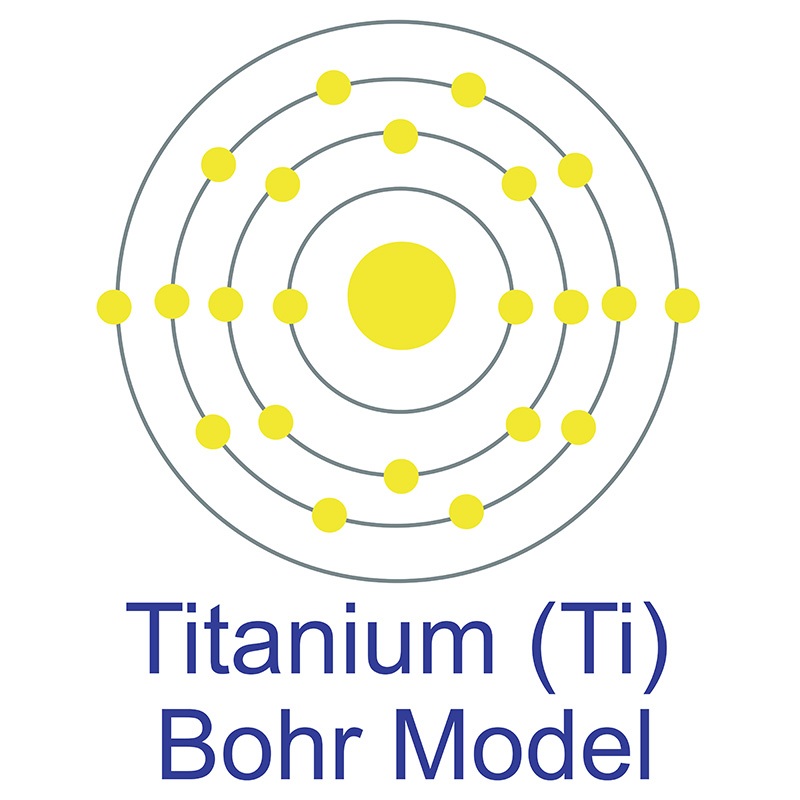
Titanium is a Block D, Group 4, Period 4 element. The electronic configuration is [Ar] 3d2 4s2. In its elemental form titanium's CAS number is 7440-32-6. The titanium atom has a radius of 144.8.pm and it's Van der Waals radius is 200.pm. In its metallic form it is not only very strong and light weight, but also highly resistant to corrosion. Thus it can be found in numerous aerospace and military applications. In its oxide form it used in low grades to produce a white pigment. Titanium is the bases for numerous commercially essential compound groups, such as titanium titanates in electronic and di-electric formulations and in crystal growth for ruby and sapphire lasers. Titanium information, including Technical Data, Safety Data and its high purity properties, research, applications and other useful facts are discussed here. Scientific facts such as the atomic structure, ionization energy , abundance on Earth, conductivity and thermal properties are included.

Aluminum is a Block P, Group 13, Period 3 element. The electronic configuration is [Ne] 3s2 3p1. In its elemental form aluminum's CAS number is 7429-90-5. The aluminum atom has a radius of 143.2.pm and it's Van der Waals radius is 200.pm. Aluminum is a silvery-white metal that possesses many desirable characteristics. It is light, nonmagnetic and nonsparking. It stands second among metals in the scale of malleability, and sixth in ductility. It is extensively used in many industrial applications where a strong, light, easily constructed material is needed. Although it's electrical conductivity is only about 60% that of copper, it is used in electrical transmission lines because of its light weight. Pure aluminum is soft and lacks strength, but alloyed with small amounts of copper, magnesium, silicon, manganese, or other elements impart a variety of useful properties. These alloys are of vital importance in the construction of modern aircraft and rockets. Aluminum, evaporated in a vacuum, forms a highly reflective coating for both visible light and radiant heat. They are used to coat telescope mirrors. Aluminum is available as metal and compounds with purities from 99% to 99.9999% (ACS grade to ultra-high purity); metals in the form of foil, sputtering target, and rod, and compounds as submicron and nanopowder.

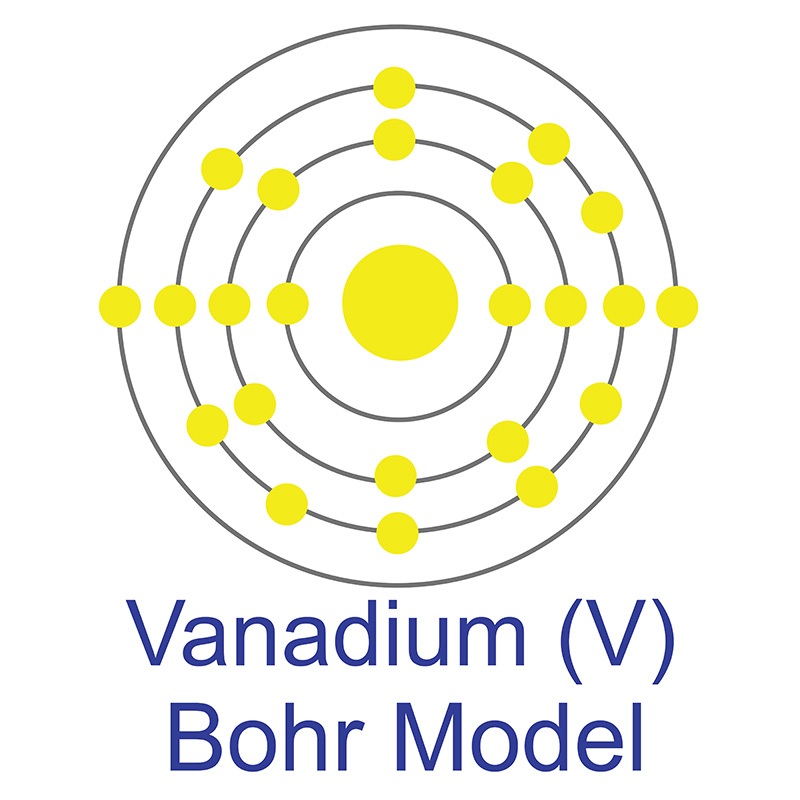
Vanadium is a Block D, Group 5, Period 4 element. The electronic configuration is [Ar] 3d3 4s2. In its elemental form vanadium's CAS number is 7440-62-2. The vanadium atom has a radius of 131.1.pm and it's Van der Waals radius is 200.pm. Vanadium is highly resistant to corrosion, so it is commonly used to alloy stainless steel grades. Vanadium compounds are used in advanced ceramics. Vanadium is a petrochemical cracking catalyst. Vanadium is available as metal and compounds with purities from 99% to 99.999% (ACS grade to ultra-high purity); metals in the form of foil, sputtering target, and rod, and compounds as submicron and nanopowder. Vanadium information, including Technical Data, Safety Data and its high purity properties , research , applications and other useful facts are discussed here . Scientific facts such as the atomic structure, ionization energy , abundance on Earth , conductivity and thermal properties are included. Vanadium was first discovered in Mexico City by Andres Manuel del Rio, a Spanish born and European educated Mexican mineralogist, in 1801.

Formula CAS No. Appearance Molecular Weight
Ti 6Al4V    
PRODUCT CATALOG Submicron & Nanopowder Tolling Ultra High Purity Sputtering Target Crystal Growth Rod, Plate, Powder, etc.
German   Korean   French   Japanese   Spanish   Chinese (Simplified)   Portuguese   Russian   Chinese (Taiwan)   Italian   Turkish   Polish   Dutch   Czech   Swedish   Hungarian   Danish   Hebrew

Production Catalog Available in 32 Countries
 
Periodic table of the elements science and academic information, elements and advanced materials data, scientific presentations and all pages, designs, concepts, logos, and color schemes herein are the copyrighted proprietary rights and intellectual property of American Elements. American Elements is a U.S. Registered Trademark. © 2001-2009. American Elements. All rights reserved.


Recent Research & Development for Titanium

  • Controllable preparation of microscale tubes with multiphase co-laminar flow in a double co-axial microdevice. Lan W, Li S, Lu Y, Xu J, Luo G. Lab Chip. 2009 Nov 21;9(22):3282-8. Epub 2009 Sep 17. PMID: 19865737 [PubMed - in process]

  • Bone formation around immediately loaded and submerged dental implants with a modified sandblasted and Acid-etched surface after 4 and 8 weeks: a human histologic and histomorphometric analysis. Degidi M, Piattelli A, Shibli JA, Perrotti V, Iezzi G. Int J Oral Maxillofac Implants. 2009 Sep-Oct;24(5):896-901. PMID: 19865630 [PubMed - in process]

  • Biomechanical properties of jaw periosteum-derived mineralized culture on different titanium topography. Att W, Kubo K, Yamada M, Maeda H, Ogawa T. Int J Oral Maxillofac Implants. 2009 Sep-Oct;24(5):831-41. PMID: 19865623 [PubMed - in process]

  • The role of titanium implant surface modification with hydroxyapatite nanoparticles in progressive early bone-implant fixation in vivo. Lin A, Wang CJ, Kelly J, Gubbi P, Nishimura I. Int J Oral Maxillofac Implants. 2009 Sep-Oct;24(5):808-16. PMID: 19865620 [PubMed - in process]

  • Rat model for studying tissue changes induced by the mechanical environment surrounding loaded titanium implants. Hou X, Weiler MA, Winger JN, Morris JR, Borke JL. Int J Oral Maxillofac Implants. 2009 Sep-Oct;24(5):800-7. PMID: 19865619 [PubMed - in process]

  • Effect of electrochemically deposited nanohydroxyapatite on bone bonding of sandblasted/dual Acid-etched titanium implant. He F, Yang G, Wang X, Zhao S. Int J Oral Maxillofac Implants. 2009 Sep-Oct;24(5):790-9. PMID: 19865618 [PubMed - in process]

  • .Eu-Doped BaTiO(3) Powder and Film from Sol-Gel Process with Polyvinylpyrrolidone Additive. García-Hernández M, García-Murillo A, de J Carrillo-Romo F, Jaramillo-Vigueras D, Chadeyron G, De la Rosa E, Boyer D. Int J Mol Sci. 2009 Sep 17;10(9):4088-101. PMID: 19865533 [PubMed - in process]

  • Enhanced photocatalytic activity for titanium dioxide by co-modifying with silica and fluorine. Yang S, Sun C, Li X, Gong Z, Quan X. J Hazard Mater. 2009 Oct 6. [Epub ahead of print] PMID: 19864060 [PubMed - as supplied by publisher]

  • Outcomes of type II thyroplasty for adductor spasmodic dysphonia: analysis of revision and unsatisfactory cases. Sanuki T, Isshiki N. Acta Otolaryngol. 2009 Nov;129(11):1287-93. PMID: 19863326 [PubMed - in process]

  • Efficient Synthesis of Naphtho[1,2-e][1,3]oxazine Derivatives via a Chemoselective Reaction with the Aid of Low-Valent Titanium Reagent. Shi D, Rong S, Dou G, Wang M. J Comb Chem. 2009 Oct 28. [Epub ahead of print] PMID: 19863097 [PubMed - as supplied by publisher]

  • Plaque Accumulation on Exposed Titanium Surfaces and Peri-implant Tissue Behavior. A Preliminary 1-Year Clinical Study. Baldi D, Menini M, Pera F, Ravera G, Pera P. Int J Prosthodont. 2009 Sep-Oct;22(4):447-55. PMID: 19862378 [PubMed - in process]

  • Effects of micrometric titanium particles on osteoblast attachment and cytoskeleton architecture. Saldaña L, Vilaboa N. Acta Biomater. 2009 Oct 24. [Epub ahead of print] PMID: 19861182 [PubMed - as supplied by publisher]

  • Biomineralized strontium substituted apatite/titanium dioxide coating on titanium surfaces. Xia W, Lindahl C, Lausmaa J, Borchardt P, Ballo A, Thomsen P, Engqvist H. Acta Biomater. 2009 Oct 24. [Epub ahead of print] PMID: 19861177 [PubMed - as supplied by publisher]

  • Evaluation of the bacterial diversity among and within individual venous leg ulcers using bacterial tag-encoded FLX and Titanium amplicon pyrosequencing and metagenomic approaches. Wolcott RD, Gontcharova V, Sun Y, Dowd SE. BMC Microbiol. 2009 Oct 27;9(1):226. [Epub ahead of print] PMID: 19860898 [PubMed - as supplied by publisher]

  • Multidisciplinary approach to expansion thoracoplasty for congenital spinal deformity: A preliminary report. Sherwood W, Lakhoo K. Afr J Paediatr Surg. 2008 Jul-Dec;5(2):71-2.

  • PTH improves titanium implant fixation more than pamidronate or renutrition in osteopenic rats chronically fed a low protein diet. Dayer R, Brennan TC, Rizzoli R, Ammann P. Osteoporos Int. 2009 Oct 27. [Epub ahead of print] PMID: 19859647 [PubMed - as supplied by publisher]

  • Synthesis and characterization of the titanium complexes bearing two regioisomeric trifluoromethyl-containing enaminoketonato ligands and their behavior in ethylene polymerization. Ye WP, Mu HL, Shi XC, Cheng YX, Li YS. Dalton Trans. 2009 Nov 21;(43):9452-65. Epub 2009 Sep 11. PMID: 19859601 [PubMed - in process]

  • Electron spin relaxation of exchange coupled pairs of transition metal ions in solids. Ti(2+)-Ti(2+) pairs and single Ti(2+) ions in SrF(2) crystals. Hoffmann SK, Lijewski S, Goslar J, Ulanov VA. J Magn Reson. 2009 Sep 29. [Epub ahead of print] PMID: 19857979 [PubMed - as supplied by publisher]

  • Toxicological characteristics of nanoparticulate anatase titanium dioxide in mice. Duan Y, Liu J, Ma L, Li N, Liu H, Wang J, Zheng L, Liu C, Wang X, Zhao X, Yan J, Wang S, Wang H, Zhang X, Hong F. Biomaterials. 2009 Oct 24. [Epub ahead of print] PMID: 19857890 [PubMed - as supplied by publisher]

  • Biological responses of human osteoblasts and osteoclasts to flame sprayed coatings of hydroxyapatite and fluorapatite blends. Bhadang KA, Holding CA, Thissen H, McLean KM, Forsythe JS, Haynes DR. Acta Biomater. 2009 Oct 23. [Epub ahead of print] PMID: 19857609 [PubMed - as supplied by publisher]


American Elements Products can also be sourced at these sites: