American Elements Logo and U.S. Registered Trademark


AlGaSb
High Purity AlGaSb
Product Product Code Order or Specifications
(2N) 99% AlGaSb AL-GASB-02-C Contact American Elements
(3N) 99.9% AlGaSb AL-GASB-03-C Contact American Elements
(4N) 99.99% AlGaSb AL-GASB-04-C Contact American Elements
(5N) 99.999% AlGaSb AL-GASB-05-C Contact American Elements


AlGaSb is a crystalline solid used as a semiconductor and in photo optic applications.American Elements produces to many standard grades when applicable, including Mil Spec (military grade); ACS, Reagent and Technical Grade; Food, Agricultural and Pharmaceutical Grade; Optical Grade, USP and EP/BP (European Pharmacopoeia/British Pharmacopoeia)and follows applicable ASTM testing standards.Typical and custom packaging is available. Additional technical, research and safety (MSDS) information is available as is a Reference Calculator for converting relevant units of measurement.

Aluminum(Al) atomic and molecular weight, atomic number and elemental symbolAluminum is a Block P, Group 13, Period 3 element. The number of electrons in each of Aluminum's shells is 2, 8, 3 and its electronic configuration is [Ne] 3s2 3p1. In its elemental form aluminum's CAS number is 7429-90-5. The aluminum atom has a radius of 143.2.pm and it's Van der Waals radius is 200.pm. Aluminum is not known to be harmful but ingestion may cause Alzheimer's disease.Aluminum is a silvery-white metal that possesses many desirable characteristics. It is light, nonmagnetic and nonsparking. It stands second among metals in the scale of malleability, and sixth in ductility. It is extensively used in manyAluminum Bohr Model industrial applications where a strong, light, easily constructed material is needed. Although it's electrical conductivity is only about 60% that of copper, it is used in electrical transmission Elemental Aluminumlines because of its light weight. Pure aluminum is soft and lacks strength, but alloyed with small amounts of copper, magnesium, silicon, manganese, or other elements impart a variety of useful properties. These alloys are of vital importance in the construction of modern aircraft and rockets. Aluminum, evaporated in a vacuum, forms a highly reflective coating for both visible light and radiant heat. They are used to coat telescope mirrors. Aluminum is available as metal and compounds with purities from 99% to 99.9999% (ACS grade to ultra-high purity); metals in the form of foil, sputtering target, and rod, and compounds as submicron and nanopowder. See Aluminum research below.

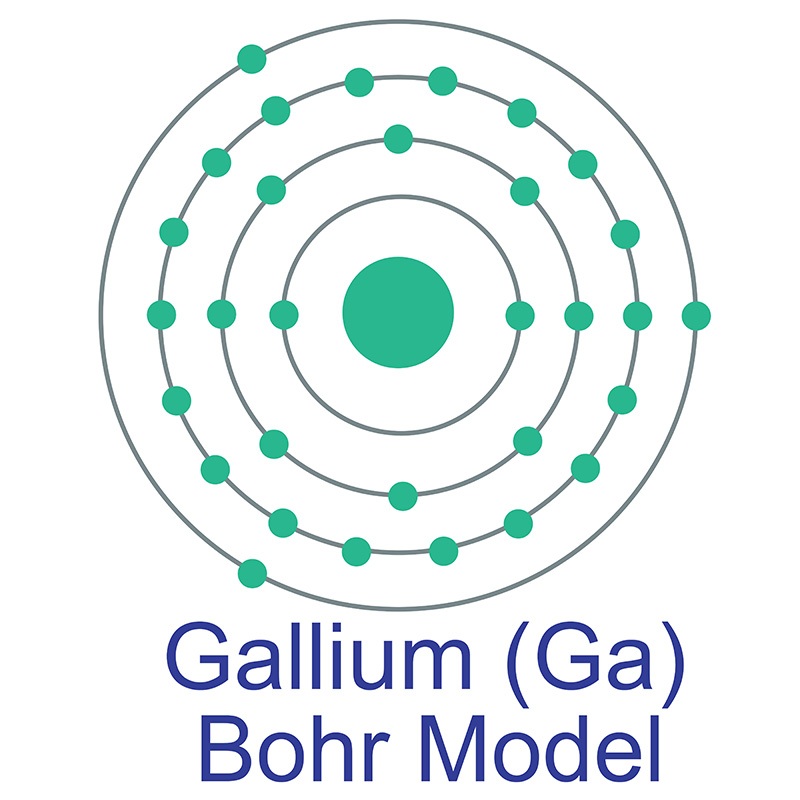
Gallium(Ga) atomic and molecular weight, atomic number and elemental symbol Gallium is a Block P, Group 13, Period 4 element. The number of electrons in each of Gallium's shells is 2, 8, 18, 3 and its electronic configuration is [Ar] 3d10 4s2 4p1. In its elemental form gallium's CAS number is 7440-55-3. The gallium atom has a radius of 122.1.pm and it's Van der Waals radius is 187.pm. Gallium is not toxic. Gallium is one of three elements that naturally occur as a liquid at room temperature. The other two are mercury and cesium. The application of gallium that has received the most attention is the production of semiconducting compounds. Of these, the Gallium Bohr ModelmostElemental Gallium important are the compounds of gallium with antimony, arsenic or phosphor. Nowadays gallium arsenide (Ga-As) is undoubtedly the most used. This compound is used in the production of several electronic parts such as diodes and transistors, made for voltage rectification, signal amplification, etc. Other gallium arsenide applications are the semiconductor "lasing" and microwave generation and also in sensors to measure temperature, light or magnetic field. Gallium was first discovered by Hans Christian Oersted in 1825. See Gallium research below. Selenium is a Block P, Group 16, Period 4 element. The number of electrons in each of Selenium's shells is 2, 8, 18, 6 and its electronic configuration is [Ar] 3d10 4s2 4p4. In its elemental form selenium's CAS number is 7782-49-2. The selenium atom has a radius of 116.pm and it's Van der Waals radius is 190.pm. The EPA does not classify selenium as carcinogenic, although selenium sulfide Elemental Seleniumis a probable carcinogen. Selenates and selenites which are compounds of selenium, are highly toxic. Hydrogen selenide gas (SeH2) is the most acutely toxic compound of selenium. Selenium exhibits both photovoltaic action, where light is converted directly into electricity, and photoconductive action, where the electrical resistance decreases with increased illumination. of photocells and exposure meters for photographic use, as well as solar cells. Below its melting point, selenium is a p-type semiconductor and has many uses in electronic and solid-state applications. Selenium is available as metal and compounds with purities from 99% to 99.9999% (ACS grade to ultra-high purity); metals in the form of foil, sputtering target, and rod, and compounds as submicron and nanopowder. Selenium was first discovered by Jons Berzelius in 1817. The origin of the name Selenium comes from the Greek word "Selênê" meaning moon. See selenium research below.

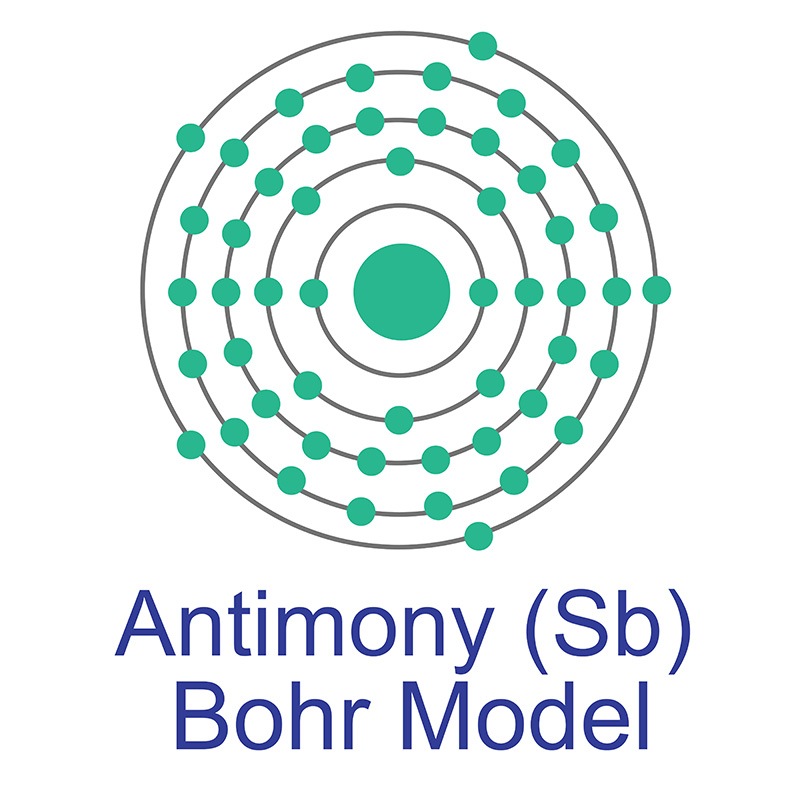
Antimony(Sb)atomic and molecular weight, atomic number and elemental symbolAntimony is a Block P, Group 15, Period 5 element. The number of electrons in each of Antimony's shells is 2, 8, 18, 18, 5 and its electronic configuration is [Kr] 4d10 5s2 5p3. In its elemental form antimony's CAS number is 7440-36-0. The antimony atom has a radius of 145.pm and it's Van der Waals radius is 200.pm. The chemical state of antimony affects the toxicity of the element and its compounds. Antimony is finding use in semiconductor technology for making infrared detectors, diodes and Hall-effect devices in crystalline structures, such as antimony telluride and gallium antimonide. Antimony is however a poor conductor of heat and electricity. It greatly increases the hardness and mechanical strength of lead. This has found applications in batteries, antifriction alloys, small arms and tracer bullets and cable sheathing. Antimony compounds are used in manufacturing flame-proofing compounds, paints, ceramic enamels, glass, and pottery glazes. Antimony is available as metal and compounds with purities from 99% to 99.9999% (ACS grade to ultra-high purity); metals in the form of foil, sputtering target, and rod, and compounds as submicron and nanopowder. See Antimony research below.

American Elements semi conducting materials are crystal structures produced from ultra high purity starting materials synthesized by our high purity production facility which includes several large electric muffle furnaces, a tube furnace for hydrogen reduction, 50 gallon glass-lined Pfaudler reactors supported by our analytical laboratory containing X-ray diffraction, SEM, AA, BET surface area, and ICP Spectrometry for trace metals analysis. See a discussion of American Elements Ultra High Purity and Analytical capabilities. See Crystal Growth for processes used to fabricate semiconductor materials, which include:

  • Crystal "pulling" by the Czochaiski method for production of semiconductor materials
  • Flux growth and gradient freeze
  • Directional solidification of fluorites using both the Bridgman-Stockbarger and float zoning techniques
PRODUCT CATALOG Aluminum Products News Foil Submicron & Nanopowder Tolling Ultra High Purity Sputtering Target Crystal Growth Rod, Plate, Powder, etc. Home

Have a Question? Ask a Chemical Engineer or Material Scientist   Request an MSDS or Certificate of Analysis


Search by Material, Product Name, Product Code, CAS Number, Formula, Element, Anion, Form, EC Number, MDL Number or PubChem ID.


German   Korean   French   Japanese   Spanish   Chinese (Simplified)   Portuguese   Russian   Chinese (Taiwan)  Italian   Turkish   Polish   Dutch   Czech   Swedish   Hungarian   Danish   Hebrew

Production Catalog Available in 36 Countries & Languages


Customers for this product have also looked at:


Recent Research & Development for Aluminum

  • Characterisation of optically stimulated luminescence dosemeters to measure organ doses in diagnostic radiology. Endo A, Katoh T, Kobayashi I, Joshi R, Sur J, Okano T. Dentomaxillofac Radiol. 2011 Nov 24. [Epub ahead of print] PMID: 22116136 [PubMed - as supplied by publisher]

  • Metal recovery from high-grade WEEE: A life cycle assessment. Bigum M, Brogaard L, Christensen TH. J Hazard Mater. 2011 Oct 17. [Epub ahead of print] PMID: 22115841 [PubMed - as supplied by publisher]

  • Protein interactions with nanosized hydrotalcites of different composition. Bellezza F, Alberani A, Posati T, Tarpani L, Latterini L, Cipiciani A. J Inorg Biochem. 2011 Oct 8;106(1):134-142. [Epub ahead of print] PMID: 22115829 [PubMed - as supplied by publisher]

  • Neurobehavioral toxic effects of perinatal oral exposure to aluminum on the developmental motor reflexes, learning, memory and brain neurotransmitters of mice offspring. Abu-Taweel GM, Ajarem JS, Ahmad M. Pharmacol Biochem Behav. 2011 Nov 13. [Epub ahead of print] PMID: 22115621 [PubMed - as supplied by publisher]

  • Lithium-Ion Conducting Electrolyte Salts for Lithium Batteries. Aravindan V, Gnanaraj J, Madhavi S, Liu HK. Chemistry. 2011 Nov 24. doi: 10.1002/chem.201101486. [Epub ahead of print] PMID: 22114046 [PubMed - as supplied by publisher]

  • Contact fatigue response of porcelain-veneered alumina model systems. Stappert CF, Baldassarri M, Zhang Y, Stappert D, Thompson VP. J Biomed Mater Res B Appl Biomater. 2011 Nov 24. doi: 10.1002/jbm.b.31977. [Epub ahead of print] PMID: 22113973 [PubMed - as supplied by publisher]

  • Influence of formulation pH and suspension state on freezing-induced agglomeration of aluminum adjuvants. Salnikova MS, Davis H, Mensch C, Celano L, Thiriot DS. J Pharm Sci. 2011 Nov 23. doi: 10.1002/jps.22815. [Epub ahead of print] PMID: 22113733 [PubMed - as supplied by publisher]

  • Evidence of foliar aluminium accumulation in local, regional and global datasets of wild plants. Metali F, Salim KA, Burslem DF. New Phytol. 2011 Nov 23. doi: 10.1111/j.1469-8137.2011.03965.x. [Epub ahead of print] PMID: 22111583 [PubMed - as supplied by publisher]

  • Turning aluminium into a noble-metal-like catalyst for low-temperature activation of molecular hydrogen. Chopra IS, Chaudhuri S, Veyan JF, Chabal YJ. Nat Mater. 2011 Nov 23;10(12):986. doi: 10.1038/nmat3174. No abstract available. PMID: 22109610 [PubMed - in process]

  • Fabrication of a dual-layer aluminum nanowires polarization filter array. Gruev V. Opt Express. 2011 Nov 21;19(24):24361-9. doi: 10.1364/OE.19.024361. PMID: 22109463 [PubMed - in process]

  • Image-quality perception as a function of dose in digital radiography. Lehnert T, Naguib NN, Korkusuz H, Bauer RW, Kerl JM, Mack MG, Vogl TJ. AJR Am J Roentgenol. 2011 Dec;197(6):1399-403. PMID: 22109295 [PubMed - in process]

  • Highly sensitive nano-porous lattice biosensor based on localized surface plasmon resonance and interference. Yeom SH, Kim OG, Kang BH, Kim KJ, Yuan H, Kwon DH, Kim HR, Kang SW. Opt Express. 2011 Nov 7;19(23):22882-91. doi: 10.1364/OE.19.022882. PMID: 22109166 [PubMed - in process]

  • Regulatory role of zinc during aluminium-induced altered carbohydrate metabolism in rat brain. Singla N, Dhawan DK. J Neurosci Res. 2011 Nov 23. doi: 10.1002/jnr.22790. [Epub ahead of print] PMID: 22108899 [PubMed - as supplied by publisher]

  • Three-shell-based lens barrel for the effective athermalization of an IR optical system. Yang HS, Kihm H, Moon IK, Jung GJ, Choi SC, Lee KJ, Hwang HY, Kim SW, Lee YW. Appl Opt. 2011 Nov 20;50(33):6206-13. doi: 10.1364/AO.50.006206. PMID: 22108878 [PubMed - in process]

  • Influences of heat seal lacquer thickness on the quality of blister packages. Mühlfeld L, Langguth P, Häusler H, Hagels H. Eur J Pharm Sci. 2011 Nov 16. [Epub ahead of print] PMID: 22108348 [PubMed - as supplied by publisher]

  • Efficient extraction of vaccines formulated in aluminum hydroxide gel by including surfactants in the extraction buffer. Zhu D, Huang S, McClellan H, Dai W, Syed NR, Gebregeorgis E, Mullen GE, Long C, Martin LB, Narum D, Duffy P, Miller LH, Saul A. Vaccine. 2011 Nov 18. [Epub ahead of print] PMID: 22107848 [PubMed - as supplied by publisher]

  • Electronic structure investigation of highly compressed aluminum with k edge absorption spectroscopy. Benuzzi-Mounaix A, Dorchies F, Recoules V, Festa F, Peyrusse O, Levy A, Ravasio A, Hall T, Koenig M, Amadou N, Brambrink E, Mazevet S. Phys Rev Lett. 2011 Oct 14;107(16):165006. Epub 2011 Oct 13. PMID: 22107398 [PubMed - in process]

  • Short-time electron dynamics in aluminum excited by femtosecond extreme ultraviolet radiation. Medvedev N, Zastrau U, Förster E, Gericke DO, Rethfeld B. Phys Rev Lett. 2011 Oct 14;107(16):165003. Epub 2011 Oct 12. PMID: 22107395 [PubMed - in process]

  • Nanoporous Polymeric Nanofibers Based on Selectively Etched PS-b-PDMS Block Copolymers. Birlik Demirel G, Buyukserin F, Morris MA, Demirel G. ACS Appl Mater Interfaces. 2011 Nov 22. [Epub ahead of print] PMID: 22107361 [PubMed - as supplied by publisher]

  • Low bias electron scattering in structure-identified single wall carbon nanotubes: role of substrate polar phonons. Chandra B, Perebeinos V, Berciaud S, Katoch J, Ishigami M, Kim P, Heinz TF, Hone J. Phys Rev Lett. 2011 Sep 30;107(14):146601. Epub 2011 Sep 28. PMID: 22107221 [PubMed - in process]
Customers for this product have also looked at:
Gallium Acetylacetonate Gallium Acetate Gallium Fluoride Gallium Sputtering Target Gallium Chloride
Gallium Rod Gallium Oxide Pellets Gallium Oxide Nanopowder Gallium Oxide Powder Gallium Pellets
Gadolinium Gallium Garnet-GGG Copper Gallium Sputtering Target Gallium Metal Gallium Foil Gallium Oxide


Recent Research & Development for Gallium

  • Synthesis of fluoranthenes by hydroarylation of alkynes catalyzed by gold(I) or gallium trichloride. Pascual S, Bour C, de Mendoza P, Echavarren AM. Beilstein J Org Chem. 2011;7:1520-5. Epub 2011 Nov 14. PMID: 22238527 [PubMed - in process]

  • Radioguided surgery in neuroendocrine tumors using ga-68-labeled somatostatin analogs: a pilot study. Kaemmerer D, Prasad V, Daffner W, Haugvik SP, Senftleben S, Baum RP, Hommann M. Clin Nucl Med. 2012 Feb;37(2):142-7. PMID: 22228336 [PubMed - in process]

  • Complexation of Metal Ions with TRAP (1,4,7-Triazacyclononane Phosphinic Acid) Ligands and 1,4,7-Triazacyclononane-1,4,7-triacetic Acid: Phosphinate-Containing Ligands as Unique Chelators for Trivalent Gallium. Simecek J, Schulz M, Notni J, Plutnar J, Kubícek V, Havlícková J, Hermann P. Inorg Chem. 2012 Jan 2;51(1):577-90. Epub 2011 Dec 20. PMID: 22221285 [PubMed - in process]

  • A Sterically Demanding Iminopyridine Ligand Affords Redox-Active Complexes of Aluminum(III) and Gallium(III). Myers TW, Berben LA. Inorg Chem. 2012 Jan 5. [Epub ahead of print] PMID: 22220939 [PubMed - as supplied by publisher]

  • Report from the 1(st )World Congress on Gallium-68 and Peptide Receptor Radio Nuclide Therapy (PRRNT), Bad Berka (Germany), June 23-26, 2011. Jurgilewicz D. Nucl Med Rev Cent East Eur. 2011;14(2):125-6. No abstract available. PMID: 22219158 [PubMed - in process]

  • Molecular effects of gallium on osteoclastic differentiation of mouse and human monocytes. Verron E, Loubat A, Carle GF, Vignes-Colombeix C, Strazic I, Guicheux J, Rochet N, Bouler JM, Scimeca JC. Biochem Pharmacol. 2011 Dec 19. [Epub ahead of print] PMID: 22202439 [PubMed - as supplied by publisher]

  • The ARRONAX Project. Haddad F, Barbet J, Chatal JF. Curr Radiopharm. 2011 Jul 1;4(3):186-96. PMID: 22201708 [PubMed - in process]

  • Differential Cytostatic and Cytotoxic Action of Metallocorroles against Human Cancer Cells: Potential Platforms for Anticancer Drug Development. Lim P, Mahammed A, Okun Z, Saltsman I, Gross Z, Gray HB, Termini J. Chem Res Toxicol. 2012 Jan 10. [Epub ahead of print] PMID: 22185566 [PubMed - as supplied by publisher]

  • Autonomic Restoration of Electrical Conductivity. Blaiszik BJ, Kramer SL, Grady ME, McIlroy DA, Moore JS, Sottos NR, White SR. Adv Mater. 2011 Dec 20. doi: 10.1002/adma.201102888. [Epub ahead of print] PMID: 22183927 [PubMed - as supplied by publisher]

  • Dependence of the Redshifted and Blueshifted Photoluminescence Spectra of Single In_{x}Ga_{1-x}As/GaAs Quantum Dots on the Applied Uniaxial Stress. Jöns KD, Hafenbrak R, Singh R, Ding F, Plumhof JD, Rastelli A, Schmidt OG, Bester G, Michler P. Phys Rev Lett. 2011 Nov 18;107(21):217402. Epub 2011 Nov 15. PMID: 22181923 [PubMed - in process]

  • Second line salvage chemotherapy for transplant-eligible patients with Hodgkin lymphoma resistant to platinum-containing first-line salvage chemotherapy. Villa D, Seshadri T, Puig N, Massey C, Tsang R, Keating A, Crump M, Kuruvilla J. Haematologica. 2011 Dec 16. [Epub ahead of print] PMID: 22180434 [PubMed - as supplied by publisher]

  • Hole spin relaxation in Ge-Si core-shell nanowire qubits. Hu Y, Kuemmeth F, Lieber CM, Marcus CM. Nat Nanotechnol. 2011 Dec 18;7(1):47-50. doi: 10.1038/nnano.2011.234. PMID: 22179569 [PubMed - in process]

  • Synthesis, radiometal labeling and in vitro evaluation of a targeted PPIX derivative. Behnam Azad B, Cho CF, Lewis JD, Luyt LG. Appl Radiat Isot. 2012 Mar;70(3):505-11. Epub 2011 Dec 6. PMID: 22178308 [PubMed - in process]

  • Leukemia, thyroiditis and gallium-67 scan. Wiwanitkit V. Indian J Med Paediatr Oncol. 2011 Apr;32(2):122. No abstract available. PMID: 22174505 [PubMed - in process]

  • Unusual presentation of mycosis fungoides as a lump in the scalp. Imran MB, Othman S, Shahid A. Singapore Med J. 2011 Nov;52(11):e226-8. PMID: 22173261 [PubMed - in process]

  • (68)Ga-labeling and in vivo evaluation of a uPAR binding DOTA- and NODAGA-conjugated peptide for PET imaging of invasive cancers. Persson M, Madsen J, Ostergaard S, Ploug M, Kjaer A. Nucl Med Biol. 2011 Dec 13. [Epub ahead of print] PMID: 22172391 [PubMed - as supplied by publisher]

  • Cathodoluminescence spectra of gallium nitride nanorods. Tsai CC, Li GH, Lin YT, Chang CW, Wadekar P, Chen QY, Rigutti L, Tchernycheva M, Julien FH, Tu LW. Nanoscale Res Lett. 2011 Dec 14;6(1):631. [Epub ahead of print] PMID: 22168896 [PubMed - as supplied by publisher]

  • Design of neutral lewis superacids of group 13 elements. Mück LA, Timoshkin AY, Frenking G. Inorg Chem. 2012 Jan 2;51(1):640-6. Epub 2011 Dec 14. PMID: 22168307 [PubMed - in process]

  • Role of Gallium-67 scintigraphy in the evaluation of occult sepsis in the medical ICU. Chen WC, Tsai KD, Chen CH, Lin MS, Chen CM, Shih CM, Chen W. Intern Emerg Med. 2011 Dec 14. [Epub ahead of print] PMID: 22167445 [PubMed - as supplied by publisher]

  • Susceptibility of Candida albicans to photodynamic therapy using methylene blue and toluidine blue as photosensitizing dyes. Pupo YM, Gomes GM, Santos EB, Chaves L, Michel MD, Kozlowski VA Jr, Gomes OM, Gomes JC. Acta Odontol Latinoam. 2011;24(2):188-92. PMID: 22165318 [PubMed - in process]


Customers for this product have also looked at:
Antimony Foil Antimony Chloride Antimony Acetate Antimony Bars Antimony Fluoride
Antimony Nitrate Antimony Nanoparticles Antimony Metal Antimony Oxide Pellets Antimony Sputtering Target
Antimony Oxide Antimony Pellets Antimony Powder Bismuth Antimony Alloy Tin Lead Antimony Alloy

Recent Research & Development for Antimony

  • Synthesis of four different antimony(III) O,O'-dialkyldithiophosphates: Characterization by (31)P CP/MAS NMR, single-crystal X-ray diffraction, and adsorption at a stibnite surface (Sb(2)S(3)). Larsson AC, Ivanov MA, Gerasimenko AV, Ivanov AV. J Colloid Interface Sci. 2011 Nov 6. [Epub ahead of print] PMID: 22115160 [PubMed - as supplied by publisher]

  • Sensing of Aqueous Fluoride Anions by Cationic Stibine-Palladium Complexes. Wade CR, Ke IS, Gabbaï FP. Angew Chem Int Ed Engl. 2011 Nov 24. doi: 10.1002/anie.201106242. [Epub ahead of print] PMID: 22113959 [PubMed - as supplied by publisher]

  • Electrical characterization of n/p-type nickel silicide/silicon junctions by Sb segregation. Jun M, Park Y, Hyun Y, Choi SJ, Zyung T, Jang M. J Nanosci Nanotechnol. 2011 Aug;11(8):7339-42. PMID: 22103191 [PubMed - in process]

  • Hydride generation in-atomizer collection atomic absorption spectrometry for the determination of antimony in acetic acid leachates from pewter cups. Dessuy MB, Kratzer J, Vale MG, Welz B, Dedina J. Talanta. 2011 Dec 15;87:255-61. Epub 2011 Oct 17. PMID: 22099676 [PubMed - in process]

  • Electrical and optical performance of transparent conducting oxide films deposited by electrostatic spray assisted vapour deposition. Hou X, Choy KL, Liu JP. J Nanosci Nanotechnol. 2011 Sep;11(9):8114-9. PMID: 22097539 [PubMed - in process]

  • Biomolecule-assisted green route to Sb2S3 crystals with three-dimensional dandelionlike patterns. Xiang W, Ji G, Wei J, Yang Y, Yuan H, Liu X. J Nanosci Nanotechnol. 2011 Sep;11(9):7820-32. PMID: 22097493 [PubMed - in process]

  • Use of antimony in the treatment of leishmaniasis: current status and future directions. Haldar AK, Sen P, Roy S. Mol Biol Int. 2011;2011:571242. Epub 2011 Jun 8. PMID: 22091408 [PubMed - in process]

  • Comparison between one day and two days protocols for sentinel node mapping of breast cancer patients. Ali J, Alireza R, Mostafa M, Naser FM, Bahram M, Ramin S. Hell J Nucl Med. 2011 Sep;14(3):313-5. PMID: 22087458 [PubMed - in process]

  • Identification of Gunshot Residues in Fabric Targets Using Sector Field Inductively Coupled Plasma Mass Spectrometry Technique and Ternary Graphs* Freitas JC, Sarkis JE, Neto ON, Viebig SB. J Forensic Sci. 2011 Nov 10. doi: 10.1111/j.1556-4029.2011.01956.x. [Epub ahead of print] PMID: 22074259 [PubMed - as supplied by publisher]

  • MAP Kinase1 of Leishmania Donovani: Down Regulation Associates With Antimony Resistance in Field Isolates. Ashutosh, Garg M, Sundar S, Duncan R, Nakhasi HL, Goyal N. Antimicrob Agents Chemother. 2011 Nov 7. [Epub ahead of print] PMID: 22064540 [PubMed - as supplied by publisher]

  • Use of carbon nanotubes and electrothermal atomic absorption spectrometry for the speciation of very low amounts of arsenic and antimony in waters. López-García I, Rivas RE, Hernández-Córdoba M. Talanta. 2011 Oct 30;86:52-7. Epub 2011 Aug 27. PMID: 22063510 [PubMed - in process]

  • Frequency of use controls chemical leaching from drinking-water containers subject to disinfection. Andra SS, Makris KC, Shine JP. Water Res. 2011 Dec 15;45(20):6677-87. Epub 2011 Oct 12. PMID: 22040714 [PubMed - in process]

  • Antimony leaching from MSWI bottom ash: Modelling of the effect of pH and carbonation. Cornelis G, Gerven TV, Vandecasteele C. Waste Manag. 2011 Oct 27. [Epub ahead of print] PMID: 22035902 [PubMed - as supplied by publisher]

  • Discovery of Safe and Orally Effective 4-Aminoquinaldine Analogues as Apoptotic Inducers with Activity against Experimental Visceral Leishmaniasis. Palit P, Hazra A, Maity A, Vijayan RS, Manoharan P, Banerjee S, Mondal NB, Ghoshal N, Ali N. Antimicrob Agents Chemother. 2011 Oct 24. [Epub ahead of print] PMID: 22024817 [PubMed - as supplied by publisher]

  • Bone marrow leishmaniasis: a review of situation in Thailand. Wiwanitkit V. Asian Pac J Trop Med. 2011 Oct;4(10):757-9. PMID: 22014727 [PubMed - in process]

  • Spectroelectrochemistry of cytochrome c and azurin immobilized in nanoporous antimony-doped tin oxide. Kwan P, Schmitt D, Volosin AM, McIntosh CL, Seo DK, Jones AK. Chem Commun (Camb). 2011 Dec 7;47(45):12367-9. Epub 2011 Oct 20. PMID: 22011849 [PubMed - in process]

  • Structural diversity for phosphine complexes of stibenium and stibinidenium cations. Chitnis SS, Peters B, Conrad E, Burford N, McDonald R, Ferguson MJ. Chem Commun (Camb). 2011 Nov 8;47(45):12331-3. Epub 2011 Oct 20. PMID: 22011846 [PubMed - in process]

  • Pressure-induced disordered substitution alloy in sb(2)te(3). Zhao J, Liu H, Ehm L, Chen Z, Sinogeikin S, Zhao Y, Gu G. Inorg Chem. 2011 Nov 21;50(22):11291-3. Epub 2011 Oct 18. PMID: 22007692 [PubMed - in process]

  • Electrospun antimony doped tin oxide (ATO) nanofibers as a versatile conducting matrix. Ostermann R, Zieba R, Rudolph M, Schlettwein D, Smarsly BM. Chem Commun (Camb). 2011 Nov 28;47(44):12119-21. Epub 2011 Oct 14. PMID: 22003493 [PubMed - in process]

  • Multi-metal(loid) methylation in methanoarchaea is linked to central intermediates of methanogenesis. Thomas F, Diaz-Bone RA, Wuerfel O, Huber B, Weidenbach K, Schmitz RA, Hensel R. Appl Environ Microbiol. 2011 Oct 14. [Epub ahead of print] PMID: 22003009 [PubMed - as supplied by publisher]


American Elements is a copyrighted U.S. Trademark. All rights reserved.